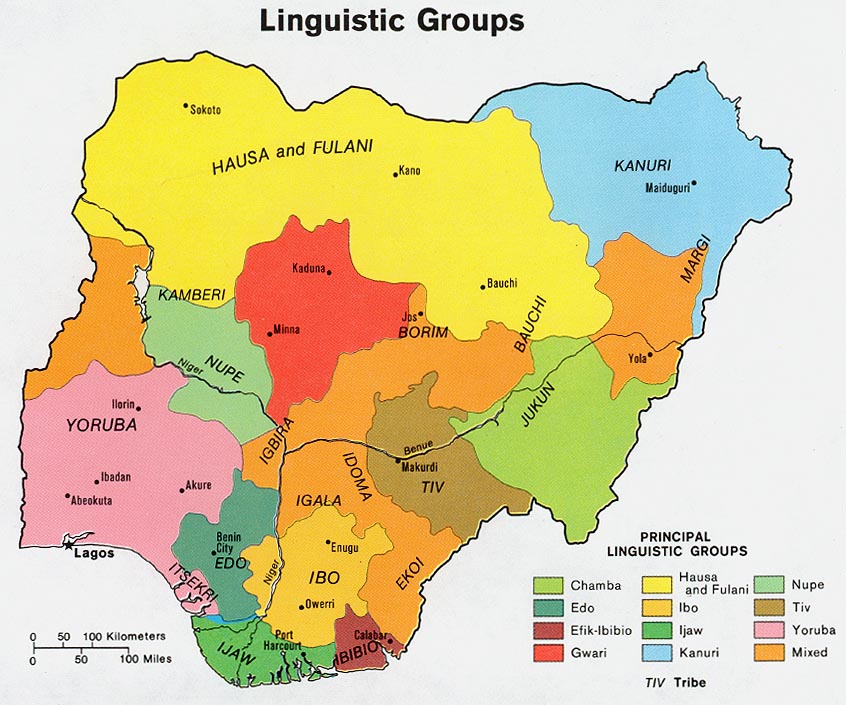
The Rumaya are a small indigenous people group living in Lere Local Government Area of Kaduna State in north-central Nigeria, in the region known as the Middle Belt. Their principal town is Saminaka, which serves as the administrative headquarters of Lere LGA and sits at an elevation that gives the area a relatively temperate climate — warm and dry by day, cooler at night compared to the surrounding lowlands. The Rumaya are also known as the Amala, and their language, Amalah, belongs to the Kainji branch of the Benue-Congo family within the larger Niger-Congo language group. Amalah has a recognized dialect called Rumaya, which is the people's own name for themselves. A secondary language, Mala, is also spoken within the community, and Hausa serves as the regional trade language connecting the Rumaya to broader markets and neighboring peoples.
The Middle Belt has long been home to scores of small, indigenous farming peoples who inhabit the space between Nigeria's predominantly Muslim north and its predominantly Christian south. The 19th-century Fulani jihad, which established the emirate system across much of northern Nigeria, brought significant pressure on the peoples of this region, displacing many communities and incorporating others under Hausa-Fulani political structures. The area that includes Lere LGA became part of the Hausa emirate system, and many minority peoples here have historically lived under conditions of political marginalization within that structure. The Rumaya are one such people — long-resident in their homeland yet little known beyond their immediate area.
The Rumaya are subsistence farmers whose lives follow the rhythms of the Sudan Savannah — planting and harvesting on loamy soils that yield sorghum, millet, guinea corn, groundnuts, and maize. Agriculture is not merely an occupation but a way of life that shapes the social calendar, defines communal identity, and organizes family labor. Men typically clear the land and handle the heavy work of planting; women process and prepare the harvest. Children are integrated into farm life from an early age. Extended family compounds are the basic unit of community life, and elders hold authority in matters of land use, dispute resolution, and customary practice.
Markets are vital social and economic spaces in the region. Saminaka is a known trading center, and farmers bring their produce to sell and exchange in local markets that draw neighboring communities together. The Hausa language, widely spoken across northern Nigeria, serves as the lingua franca that allows the Rumaya to trade and communicate across ethnic lines.
The security situation in Kaduna State casts a long shadow over everyday life. Middle Belt farming communities face serious threats from armed Fulani militant groups, whose attacks on villages, farms, and churches have killed many, burned crops, and driven thousands from their ancestral lands across the state. Kidnapping for ransom has become a persistent nightmare in the region, with Christian leaders and ordinary families among those targeted. Many Rumaya families live with fear for their physical safety as a constant companion alongside their daily agricultural labor.
The spiritual landscape of the Rumaya community is diverse and contested. Traditional ethnic religion holds the largest claim among the Rumaya, reflecting a deep-rooted animist worldview in which the forces of nature, ancestral spirits, and sacred sites govern the unseen world. These beliefs are woven into planting and harvest rituals, healing practices, and the passage of life's major events from birth to death. Islam, which spread through much of northern Nigeria via the Hausa-Fulani emirate system, has also established a significant presence among the Rumaya. A smaller portion of the community identifies as Christian. Among those Christians, evangelical believers — those who hold to personal faith in Jesus Christ and the authority of the Bible — represent a modest but meaningful presence. The Rumaya community is partially reached with the gospel but remains in great spiritual need, with the majority following pathways that lead away from saving faith in Christ.
A Bible translation in the Amalah language has been started, and audio Scripture recordings are available through Global Recordings Network, but no written Scriptures or complete New Testament have yet been produced in a language the Rumaya can fully call their own.
The Rumaya need the complete word of God in their own language. The Amalah language has no written Scripture yet, and while audio recordings and a translation effort have begun, a full Bible in the Amalah language would equip Rumaya believers to go deeper in faith and give them a firm foundation for sharing the gospel with their own people. They also need physical security — protection from the armed violence that has terrorized farming communities across Kaduna State and the freedom to work their land and worship without fear of attack. Like many rural communities in the Middle Belt, the Rumaya face limited access to healthcare, clean water, and quality education, needs that compound the vulnerability of an already marginalized people. Those who have come to faith in Christ need discipleship — trained leaders, grounded churches, and access to Scripture-based teaching — to build a genuine, lasting Christian witness in their community.
Pray for the completion of Bible translation in the Amalah language, so that the Rumaya may hear and read the living Word of God in the tongue they have spoken since childhood.
Pray for peace and protection in Kaduna State — that the violence terrorizing farming communities will end and that Rumaya families may live without fear on the land God has given them.
Pray that evangelical believers among the Rumaya will grow in boldness and biblical depth, planting churches that proclaim the full gospel to others throughout Nigeria.
Scripture Prayers for the Rumaya in Nigeria.
https://www.ethnologue.com/language/ruy/
https://globalrecordings.net/en/language/ruy
https://en.wikipedia.org/wiki/Saminaka
https://en.wikipedia.org/wiki/Lere,_Kaduna_State
https://en.wikipedia.org/wiki/Southern_Kaduna
https://www.csw.org.uk/2022/11/14/report/5853/article.htm
https://theconversation.com/explainer-factors-that-foster-conflict-in-nigerias-kaduna-state-109899
https://books.openedition.org/ifra/761-lang=en
| Profile Source: Joshua Project |