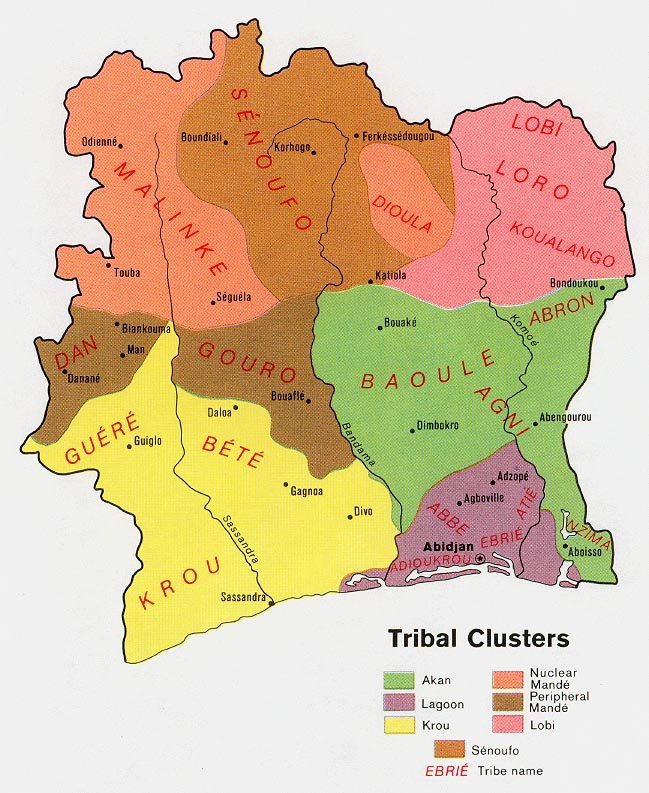
The Guebie people live in the Gôh-Djiboua district, mainly in the Gnagbodougnoa subprefecture and surrounding villages. They are part of the larger Kru peoples and speak the Guebie (Ga-ogbo) language, an Eastern Kru language.
Historical accounts describe them as descendants of groups linked to the Dida and Bété regions, with migrations and village formations shaped by internal disputes and the search for new settlement areas. Over time, their communities became established as a recognized canton within the broader Bété cultural sphere.
Most Guebie families rely on subsistence farming. They cultivate cassava, rice, corn, and plantains, while cocoa and rubber provide income when sold for profit. Villages are surrounded by forest and farmland, and daily life centers on cooperative work and seasonal rhythms.
Food staples include cassava-based dishes, plantains, and locally grown produce. Households typically involve extended family participation, with elders offering counsel and children contributing to household labor. Community celebrations often occur during agricultural seasons, village gatherings, and family milestones. Such events may include dancing and storytelling shaped by their local culture.
Road improvements and increased outside settlement in recent decades have brought greater access to nearby towns, new schools, and broader economic interactions. However, these changes have also created pressure on traditional ways of life and on the use of the Guebie language in the home.
The primary religious identity among the Guebie is tied to ethnic religious practices. Respect is shown toward the spiritual worldview inherited from ancestors, and some practices involve honoring local spirits or traditional understandings of the unseen world. Christianity is present, though not widespread. Believers affirm that Jesus Christ alone can transform lives and provide a secure foundation for hope and blessing. The gospel has a presence, but many still have limited exposure to biblical teaching.
Education is expanding, yet the use of French and Bété as school and regional languages has led to a decline in transmission of the Guebie language to younger generations. This contributes to cultural and generational disconnects. Clear access to Scripture and biblical teaching is limited, which affects discipleship and the ability of local believers to grow in Christ.
Physical and economic challenges remain, especially in rural areas where healthcare, infrastructure, and consistent income can be hard to secure. Social cohesion may also be strained as outside populations settle in the region. Continued community stability depends on wise leadership and healthy family structures supported by God's grace.
Pray for improved access to healthcare, safe drinking water, and stable livelihoods in Guebie villages.
Pray for protection of families, and for peace and unity as communities experience outside influence and change.
Pray that the Guebie language will be strengthened and preserved, and that future generations will have opportunities to hear God's word in the language they understand best.
Pray that the small Christian presence will grow deep in faith and send workers to nearby peoples who lack a gospel witness.
Scripture Prayers for the Guebie in Côte d'Ivoire.
https://par.nsf.gov/servlets/purl/10212357
https://fr.wikipedia.org/wiki/Gu%C3%A9bi%C3%A9
https://khadhormedia.com/blogs/entry/Les-origines-du-peuple-Gu-bi-Gabi
| Profile Source: Joshua Project |