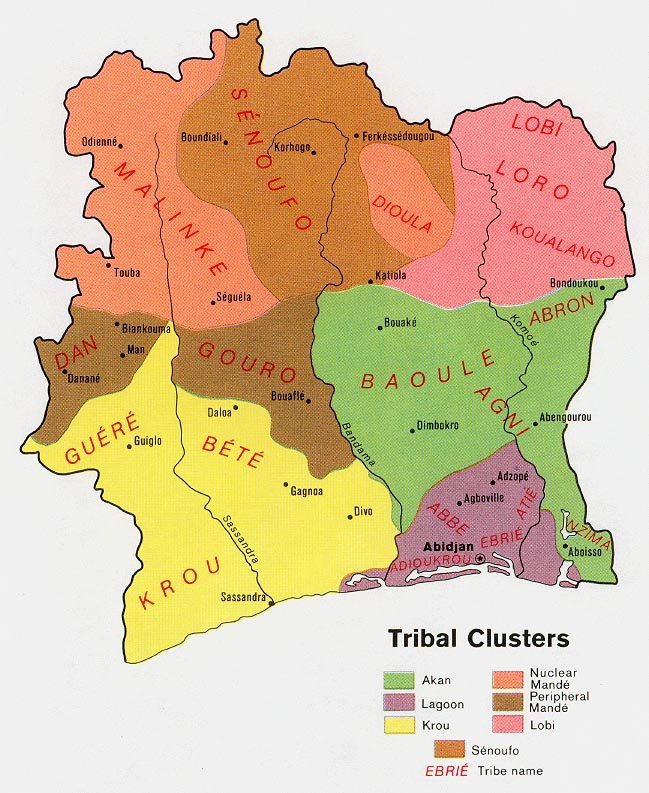
The Bakwé — pronounced "BA-kwey" — are a Kru people of the dense tropical rainforest of southwestern Côte d'Ivoire. Their territory stretches from the Gô River in the west to the Sassandra River in the east, and from the town of Soubré in the north down to the San-Pédro River in the south. Their villages fall within and around the towns of San-Pédro, Sassandra, Méagui, and Soubré. Historical evidence suggests the Bakwé were among the earliest inhabitants of the Taï Forest, one of West Africa's last great tracts of primary rainforest.
The name "Bakwé" has a colonial-era origin. When French soldiers used local men to haul canoes up the Sassandra River, they noticed one group whose chant — "ba ku--," meaning "you all pull!" — became the group's name. The Bakwé call themselves Srigbe, meaning "healer-warriors," honoring their traditional skill in forest medicine. Their language, also called Bakwé (ISO: bjw), belongs to the Kru branch of the Niger-Congo family. The Bakwé's distinctive geometric masks, shared with neighboring Kru peoples, captured the attention of European artists in the early twentieth century and are linked to the development of Cubism.
The Bakwé are subsistence farmers, growing rice and corn for household use and cacao, rubber, and teak as cash crops. The rainforest remains central to daily life — the Bakwé gather food, medicine, and building materials from the forest around them. Homes have traditionally been built of mud and stick with woven palm-shingle roofing, though cement construction is increasingly common. The pattern of a separate sleeping house and a wood-fire kitchen house persists across many compounds.
Family and clan ties organize social life. Extended households live in close proximity, and decisions around marriage, land, and community affairs are shaped by lineage relationships and the counsel of elders. Life passages — births, marriages, deaths — bring communities together for shared meals and ceremony. The Bakwé have long lived alongside neighboring peoples such as the Néyo, Bété, and Kroumen in the Bas-Sassandra region, with whom they share the forest landscape and some cultural traditions.
Christianity is the primary religion of the Bakwé. Their Christian identity was shaped significantly by the Harrist movement, which spread through southwestern Côte d'Ivoire in the early twentieth century. The Prophet William Wade Harris, a Liberian evangelist, traveled the region preaching the Ten Commandments and calling people to worship the one true God. Many Bakwé became followers, and that Christian identity has endured. Catholic and Protestant churches are both present today, and Protestant congregations have grown in recent years.
Traditional animist beliefs — the conviction that spirits inhabit the natural world and shape daily events — continue to coexist alongside Christian profession for some in the community. This blending of older spiritual practice with Christian identity is a pastoral reality the Bakwé church faces. The gospel has taken root, and a growing community of believers is emerging. The call now is for that faith to deepen, and for Bakwé followers of Jesus to become a witness not only within their community but also among the many less-reached peoples across the region. Scripture translation work in Bakwé has been underway.
Completing and distributing the full Scriptures in the Bakwé language would be a transforming gift — equipping believers to grow in faith, establish churches, and disciple their own communities with confidence. Faithful pastoral leadership and theological training for local church leaders would strengthen what the Holy Spirit is already building. Bakwé believers who are mature in Christ can become the most effective voices to their own people and neighbors.
The rainforest homeland presents barriers to healthcare, education, and economic stability. Many communities lack reliable medical care, and secondary schooling is difficult to access for children outside of larger towns. Commercial agriculture and logging in the region put pressure on the land-based livelihoods Bakwé families depend on. Ministry that addresses these practical needs alongside gospel proclamation will demonstrate the wholeness of what Jesus Christ came to give.
Pray that the Holy Spirit would deepen genuine faith across the Bakwé community — moving them beyond nominal Christian identity into a living relationship with Jesus Christ and a growing freedom from fear-based spiritual practice.
Pray for the completion and distribution of Scripture in the Bakwé language, and for literacy workers who can help the community encounter God's Word in the language of their hearts.
Pray that Bakwé believers would grow into a gospel-sending people — mature disciples who carry the message of Christ to less-reached communities throughout the Bas-Sassandra region and across West Africa.
Pray for improved access to healthcare and education in Bakwé villages, for the protection of their forest homeland, and for workers who serve practical needs as credible witnesses to the love and power of Jesus Christ.
Scripture Prayers for the Bakwe in Côte d'Ivoire.
https://christkirk.com/bakwe-mission/the-bakwe/
https://christkirk.com/bakwe-mission/the-bakwe/bakwe-culture/
https://christkirk.com/bakwe-mission/the-bakwe/bakwe-religion/
https://christkirk.com/bakwe-mission/the-goal/
https://www.peoplegroups.org/explore/GroupDetails.aspx-peid=13041
https://www.ethnologue.com/language/bjw
https://www.fomesoutra.com/info/1074-les-bakwe-un-peuple-meconnu
https://discover-ivorycoast.com/the-san-pedro-region/
https://en.wikipedia.org/wiki/Harrist_Church
https://en.wikipedia.org/wiki/Ta%C3%AF_National_Park
https://www.britannica.com/place/Cote-dIvoire
| Profile Source: Joshua Project |