


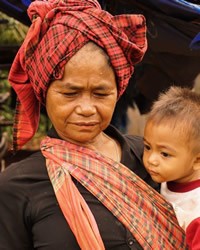

The Budeh Stieng are a subgroup of the wider Stieng people, an ethnic minority living in the borderlands of Vietnam and Cambodia, speaking a Bahnaric Mon–Khmer language. The Stieng people of Vietnam live mostly in Vietnam's Central Highlands and southeastern provinces. They speak Stieng with dialects such as Budip and Bulo, and the Budeh/Budip–Bulo distinction reflects these internal language and clan groupings rather than wholly separate peoples.
French colonial administrators allowed the Stieng considerable local autonomy in what was then Indochina. During the 19th and 20th centuries, their lands became a focal point for French colonial rubber plantations, which shifted their traditional economic structures. Later, when governments drew the modern border between Vietnam and Cambodia, officials cut directly across Stieng ancestral territory, splitting families and villages into two countries and leaving many with close relatives on both sides.
During the Vietnam War their homeland became a major theatre of conflict. They played a complex role during the Vietnam War (Second Indochina War), as their ancestral lands sat directly on the "Ho Chi Minh Trail" and the "Sihanouk Trail." This resulted in significant displacement and loss of life. American forces invaded through their region, and heavy B 52 carpet bombing devastated villages and fields, so that almost every Stieng family lost several relatives. Under the Khmer Rouge in Cambodia, authorities often accused Stieng communities of spying for the Americans and subjected them to harsh treatment and persecution until Vietnamese and allied forces overthrew the regime in offensives that again passed through Stieng areas such as Snoul.
Today, many Stieng—including Budeh Stieng in Vietnam—still live close to the border and maintain cross border family ties while navigating Vietnamese and Cambodian state structures.
Many Stieng households combine plantation agriculture with forest based livelihoods. Instead of relying primarily on wet rice cultivation, they often plant crops such as black pepper, cashew nuts and durian, while men and women also hunt and cut wood in nearby forests to supplement food and income. Stieng families frequently live in traditional houses built from palm leaves and local materials, with roof designs that differ from neighboring groups and make their homes recognizable to those who know the area. At the same time, they live close to Khmer, Vietnamese and Cham communities, and outsiders often cannot distinguish them by appearance, especially as many Stieng speak the regional majority languages fluently alongside Stieng.
In Vietnam, Stieng communities share some of the same challenges as other ethnic minorities: lower incomes, higher poverty, and weaker access to education than majority Kinh communities. At the same time, Stieng believers have participated actively in church life, including engagement with Bible translation in their own language and cross border ministry among related groups.
Historically the Stieng held strongly animistic beliefs, honoring and fearing spirits associated with forests, fields, ancestors and natural forces. Many continue to practice traditional rituals and sacrifices, while some Stieng—especially those living near Khmer communities—have adopted elements of Khmer Buddhism.
In the twentieth century and especially from the 1970s onward, Christian faith spread among the Stieng. A Stieng man named Dieu Kanh became a Christian in 1972 in Vietnam and joined other villagers in secret midnight Bible studies and forest sermons when authorities restricted open Christian practice. In the late 1980s and early 1990s, Vietnamese Stieng believers carried the gospel across the border into Stieng communities in Cambodia, and all current Stieng pastors in those areas trace their faith to this cross border, inter tribal evangelism.
Today, sources describe a large share of Stieng people—especially in Vietnam—as professing Christianity, with some estimates suggesting that a majority or a very significant minority follow Protestant churches. At the same time, many families blend Christian beliefs with lingering traditional practices, while others remain committed to ancestral animistic religion or, in some areas, to Buddhism.
Stieng communities need stable access to land, forests and agricultural resources, because land concessions and pressure from outside companies and settlers have reduced their traditional territories and livelihood options. They also need better access to schools and literacy programs, particularly in remote villages where no school functions and no education uses the Stieng language. Health care remains limited in many rural minority areas. They need culturally sensitive medical workers, maternal and child health services, and information in languages they understand. Socially they often experience low status and discrimination. They need fair treatment in local governance and markets, and representation in decisions about land, development and resources.
Stieng believers desire complete and accessible Scripture and discipleship resources in their own language. Many first encountered the Bible only in Vietnamese, and they struggled to understand it fully until translation projects began in Stieng. Churches need trained local leaders, teaching rooted in Scripture but sensitive to Stieng culture, and unity across national borders so that Stieng Christians in Vietnam and Cambodia can encourage one another.
Pray that God strengthens Budeh Stieng believers in Vietnam to follow Christ with courage and humility, and that their movement to Christ will display the hope and reconciliation found in the gospel to neighbors who still fear spirits.
Pray that the Lord completes and multiplies Stieng Bible translation and literacy efforts, so that every Stieng man, woman and child can hear and understand Scripture clearly in their own language.
Pray that Stieng churches raise up wise, servant hearted local leaders who handle Scripture faithfully, resist syncretism and shepherd their communities through pressures from both tradition and modern life.
Pray that Stieng Christians extend forgiveness and healing to those who harmed them during war and persecution, and that God turns the memories of bombing, displacement and suspicion into testimonies of his protection and grace.
Scripture Prayers for the Stieng, Budeh in Vietnam.
Stieng profile (Vietnam and Cambodia), PeopleGroups.org: https://www.peoplegroups.org/Explore/groupdetails.aspx-peid=11226peoplegroups
Wikipedia: https://en.wikipedia.org/wiki/Stieng_people
Vietnam's ethnic minorities and Bible translation, Bible Society New Zealand: https://biblesociety.org.nz/vietnams-ethnic-minorities-long-for-the-bible/biblesociety.org
Vietnam Bible Society article (Stieng New Testament, PDF): https://biblesociety.org.nz/wp-content/uploads/2024/07/WAW_254_Winter-V2-2.pdfbiblesociety.org
S'tieng ethnic group background (Vietnamese source, partial English): https://special.nhandan.vn/stieng-ethnic-group/index.htmlspecial.nhandan
General background on ethnic minorities in Vietnam, Encyclopaedia Britannica: https://www.britannica.com/place/Vietnam/Ethnic-groupsbritannica
| Profile Source: Joshua Project |



