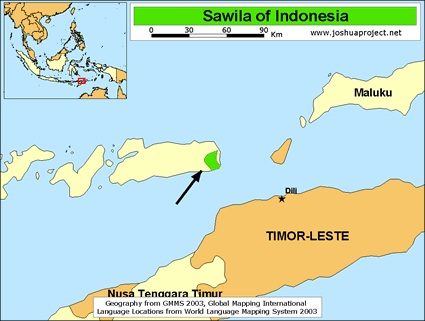
The Sawila people live on southeastern Alor Island in East Nusa Tenggara Province, Indonesia, between the Kula and Wersing language areas. They speak the Sawila language, also called Manata or Tanglapui, which belongs to the East Alor branch of the Timor-Alor-Pantar family, part of the Trans–New Guinea language group.
Historically, the Sawila have inhabited mountainous slopes and coastal areas, relying on subsistence farming and fishing. Their isolation preserved their language and traditions, but modernization and migration have introduced Indonesian as a dominant language, threatening Sawila's survival. The language is considered endangered, and younger generations increasingly use Indonesian for education and trade.
The Sawila live in small villages on rugged terrain, where family life is communal and strongly tied to agriculture. Men typically cultivate maize, cassava, and dry rice on terraced fields, while women manage household tasks and weaving. Fishing supplements their diet, and barter trade occurs between villages. Houses are simple wooden structures with thatched or tin roofs, often clustered for mutual support.
Social life revolves around family and community gatherings, with respect for elders and cooperation as core values. Celebrations include weddings and harvest festivals, often accompanied by traditional music and dance. Meals feature staples such as maize, cassava, and fish, flavored with local spices. While modernization has introduced mobile phones and basic goods, Sawila communities remain largely dependent on subsistence farming and seasonal rhythms.
The Sawila identify primarily with Christianity, introduced through missionary efforts in the 20th century. There are churches in some villages, and Christian practices such as Sunday worship and prayer are common. However, biblical understanding and discipleship are often shallow, and traditional animistic beliefs—such as reverence for spirits associated with mountains and rivers—may persist in subtle ways. This syncretism reflects a worldview that values harmony with nature alongside Christian rituals.
The Sawila face challenges related to isolation and limited infrastructure. Access to healthcare and clean water is minimal, and educational opportunities are scarce, leaving many without basic literacy skills. Economic vulnerability persists because families rely on subsistence farming and fishing, which are threatened by environmental changes. Language preservation is critical, as Sawila is endangered and not taught in schools. Spiritually, there is a need for deeper understanding of the gospel and strong discipleship to help believers grow in faith and share Christ with others.
Pray that the Sawila will experience the transforming power of Jesus Christ and that his word will take root in their hearts and communities.
Ask God to send workers who can teach Scripture clearly and disciple new believers in culturally sensitive ways.
Intercede for those who already identify as Christians, that they will grow strong in faith and become part of the global mission force.
Pray for improved access to healthcare, clean water, and education, and for wisdom to preserve their language and culture in ways that honor Christ.
Scripture Prayers for the Sawila in Indonesia.
PeopleGroups.org – Sawila
Wikipedia – Sawila Language
Ethnologue – Sawila Language
Omniglot – Sawila Language Overview
| Profile Source: Joshua Project |