


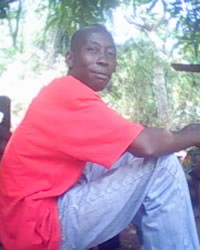

The Nzakara — also known as the Sakara, Ansakara, or Zakara — are an Adamawa-Ubangi people who inhabit the southeastern region of the Central African Republic, concentrated primarily along the Mbomou River and in and around the town of Bangassou in Mbomou Prefecture. A smaller community also lives across the border in the Democratic Republic of Congo. Their language, Nzakara, belongs to the Zande branch of the Ubangi language family and is closely related to — and sometimes mutually intelligible with — Zande proper. French and Sango, the national lingua franca, are used in formal settings, commerce, and education. Historically, the Nzakara were a state-forming people of considerable political sophistication. The Bandia clan, originally Ngbandi-speaking migrants from the Ubangi River region, moved northward and established the kingdoms of Bangassou, Rafai, and Hilou in western Zandeland, with the Bandia rulers adopting the language and customs of the Nzakara people they governed. The resulting Bangassou Kingdom became one of the most developed polities in the region, characterized by standing armies, royal courts with courtiers and harp-playing minstrels, and active trade with both Arab merchants and European explorers. The kingdom was eventually absorbed into French Equatorial Africa following treaties and the arrival of colonial administrators and Christian missionaries in the late 19th century, and the French suppressed the sultanate entirely by 1917. A Catholic mission was established in Bangassou in 1922 by the Spiritains, planting a Christian presence that has deepened across subsequent generations. Since independence in 1960, the CAR has experienced chronic political instability, and the Mbomou region has not been spared.
The Nzakara are primarily subsistence farmers, cultivating staple crops such as cassava, maize, sweet potatoes, peanuts, and plantains on small family plots. Hunting and fishing supplement the diet where rivers and savanna terrain allow, and women bear traditional responsibility for the production and preparation of food in the home. Village life is organized around extended family lineages, and the typical dwelling is built of sun-dried brick with a thatched grass roof — structures that must be regularly replaced. Men constitute most of the employed workforce outside the household, though cash income in this remote region is minimal for most families. Marriage is typically contracted through the payment of bride-wealth, and family bonds across a lineage remain the primary social safety net in the absence of reliable state services. Music and oral tradition remain vibrant elements of cultural identity, with drums, wooden gongs, and harp-like instruments accompanying community celebrations and rites of passage. The town of Bangassou is home to the Labasso Museum, which preserves archaeological and anthropological materials from the Nzakara and Zande areas, reflecting the region's rich heritage. Daily life for many Nzakara is now shadowed by ongoing civil conflict. The village of Bangassou-Nzakara has been attacked repeatedly by Lord's Resistance Army fighters — in 2013 and multiple times in 2017 — resulting in the looting of granaries and houses, the kidnapping of civilians, and the flight of entire communities into the bush. Access to healthcare, clean water, and education remains severely limited, and a single health post serves the surrounding area.
The Nzakara are a predominantly Christian people, with most of the community identifying as Christian adherents. The Catholic Church has held a deep and longstanding presence in the Bangassou region since the establishment of the Spiritan mission in 1922, and Bangassou is the seat of a Roman Catholic diocese. As is characteristic across much of the Central African Republic, however, Christian identity among the Nzakara coexists with traditional animistic beliefs. Some Christians are influenced by indigenous spiritual practices involving the spirit world, divination, and ancestral powers, and these convictions do not always disappear simply because outward Christian identity is present. The challenge facing the Nzakara church today is not the absence of the gospel but the depth of its roots — whether the faith held by the community will remain a cultural inheritance or become a living, transforming force that shapes all of life and sends workers to those who have never heard.
The physical suffering caused by repeated armed attacks in the Mbomou region has left communities in genuine crisis, with food stores looted, families displaced, and livelihoods destroyed. Access to reliable medical care is dangerously inadequate in this remote area, where a single health post may serve a vast and scattered population. Educational opportunity remains limited, particularly for children in villages where conflict has closed schools or driven families into hiding. Spiritually, the Nzakara church — though long-established — needs investment in biblical discipleship that goes beyond nominal affiliation and addresses the ongoing presence of syncretistic practices. And as a reached people with Christian roots stretching back a century, the Nzakara have the potential to become not merely recipients of the gospel but participants in carrying it to the many unreached peoples of central Africa who have never heard the name of Christ.
Pray for enduring peace in the Mbomou Prefecture, where the Nzakara have endured repeated attacks, displacement, and the loss of food and livelihood at the hands of armed groups and pray for the protection and return of all those driven from their homes.
Pray for an awakening within the Nzakara church — that what has been inherited as a cultural tradition would become a personal, living faith in Jesus Christ — and that syncretistic practices rooted in fear of the spirit world would give way to the freedom and confidence of the gospel.
Pray for the raising up of biblically grounded Nzakara pastors, teachers, and evangelists who will lead their communities into deeper knowledge of Scripture and greater Christlikeness in all areas of life.
Pray that the Nzakara church, with its century-long Christian heritage, would catch a vision for cross-cultural mission — becoming senders and goers among the many unreached and least-reached peoples of the Central African Republic and the broader region.
Scripture Prayers for the Nzakara, Sakara in Central African Republic.
| Profile Source: Joshua Project |


