


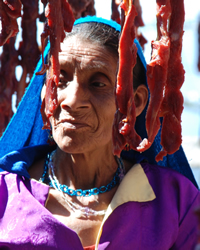

Nestled in the rugged highlands of the Sierra Mixe in the northeastern corner of Oaxaca state, the Quetzaltepec Mixe are a fiercely independent indigenous people who call themselves Ayuujkja'ay — "people who speak the mountain language." Their name in Spanish, Mixe, is likely drawn from the Nahuatl word for cloud, m-xtli, a fitting image for people whose villages cling to mist-covered mountain peaks. Their ancestral oral history tells of their legendary king Condoy, who led them to settle at the sacred mountain Cempoaltepetl, where they built a thriving kingdom. Remarkably, neither the Zapotec empire nor the Aztec armies ever succeeded in fully subduing them. When Spanish conquistadors arrived, they too met resistance; it was not military force but the Dominican friars who first made peaceful inroads in 1555, establishing a mission church in Quetzaltepec that still stands as a reminder of that encounter. The Mixe retain great pride in their unconquered heritage to this day. Their primary language, Quetzaltepec Mixe belongs to the Mixe-Zoque family and is considered endangered, as fewer young people are learning it as a first language and it is not formally taught in schools.
Daily life for the Quetzaltepec Mixe is shaped by the rhythms of the land and the bonds of community. Subsistence agriculture remains the backbone of survival, with families cultivating corn, beans, squash, and potatoes on steep hillside plots. Hunting small game and fishing in local streams and rivers supplement the diet, and meals are built around the same staple crops their ancestors grew for generations. Community governance follows the traditional cargo system, in which civic and religious offices rotate among the men of the village, binding individuals into a shared network of responsibility and service. This system means that authority is communal rather than individual, and participation in public life is an expectation, not an option.
The Quetzaltepec Mixe are known throughout Oaxaca for their vibrant brass bands; every community maintains one, and these ensembles perform at local festivals and celebrations throughout the year. Some community members continue traditional crafts such as backstrap-loom weaving, which passes down artistic knowledge across generations. The ancient 260-day Mesoamerican ritual calendar still informs certain community practices, including divination and the naming of children, who receive both a calendrical Mixe name at birth and a Spanish Catholic name at baptism. The isolation of their mountainous homeland means that access to health care, higher education, and economic opportunity remains limited, and many young people face pressure to migrate to urban centers in Oaxaca or elsewhere in Mexico.
The religious life of the Quetzaltepec Mixe is characterized by a deep, longstanding identification with Christianity, the majority faith within the community. Most people identify as Christian, with Roman Catholicism historically forming the visible framework of communal religious practice since the Dominican missions of the sixteenth century. However, this Christianity exists in a syncretic blend with indigenous Mesoamerican beliefs that were never fully displaced. The Mixe maintain reverence for traditional deities alongside Catholic observance, including a rain and fertility god, an earth goddess, a lord of animals, and other figures drawn from their pre-contact religious heritage. For many, there is no perceived contradiction between these traditions and Christian profession.
The evangelical presence within the community is modest, representing a small but meaningful witness to biblical faith that distinguishes those who have embraced a personal, scripture-grounded relationship with Jesus Christ from the broader population of nominal or syncretic Christian adherents.
Access to quality health care in the remote Sierra Mixe remains one of the most pressing physical challenges for this community, as geographic isolation makes medical attention difficult to obtain in emergencies and for chronic conditions. Economic development opportunities are scarce in the highlands, and the loss of young adults to migration weakens both family structures and the transmission of cultural and linguistic heritage to the next generation. The endangered status of the Quetzaltepec Mixe language calls for intentional efforts to preserve and pass it on, since language loss often accompanies the erosion of community identity and indigenous Christian witness alike.
Spiritually, the community needs discipleship and biblical renewal, as a profession of Christianity that is mixed with indigenous religious practices falls short of the transforming faith that comes through the mercy of Jesus Christ alone. A complete Bible has been available in the Quetzaltepec Mixe language since 2013, but access to strong biblical teaching, trained local leaders, and vibrant evangelical churches is still limited. The small community of believers needs encouragement, equipping, and connection to the wider body of Christ.
Pray that the complete Bible available in the Quetzaltepec Mixe language will be read, taught, and taken to heart in homes and churches throughout the community.
Ask God to raise up faithful, biblically grounded local pastors and teachers who can speak with authority and love into the syncretism that mixes indigenous religion with faith in Jesus Christ.
Pray for physical health and healing in a community where access to medical care is difficult and ask the Lord to raise up workers — whether doctors, nurses, or community health advocates — who can serve these mountain villages.
Intercede for young people who face the pull of migration, that they would find dignity, opportunity, and belonging without having to abandon their people and language.
Ask the Lord to strengthen and multiply the small evangelical community so that it becomes a genuine light within the broader Mixe population.
Pray that as the Quetzaltepec Mixe come to know the risen Christ in the fullness of biblical truth, they would not keep that good news to themselves but would become bold witnesses and senders among the minimally reached peoples of Oaxaca State.
Scripture Prayers for the Mixe, Quetzaltepec in Mexico.
https://en.wikipedia.org/wiki/Mixe_people
https://www.ethnologue.com/language/pxm/
https://alchetron.com/Mixe-people
https://www.languagesandnumbers.com/how-to-count-in-quetzaltepec-mixe/en/pxm/
| Profile Source: Joshua Project |



