


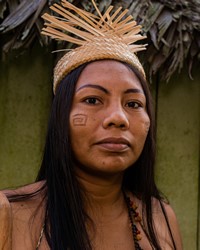

The Murui Huitoto, also known as Witoto Murui or simply Murui, are an indigenous people of the Amazon region in southern Colombia. Their language, Murui Huitoto, belongs to the Witotoan family, specifically the Bora–Witoto branch. It is spoken in Colombia, primarily along the Putumayo, Cara-Paraná, and Igara-Paraná rivers. A smaller number live in Peru.
Historically, the Murui were part of a larger Witoto population that numbered around 50,000 before the 20th century. The rubber boom brought devastating consequences, including disease, forced labor, and displacement, reducing their numbers significantly. Today, the Murui are one of the largest surviving Witoto subgroups and continue to preserve their language and traditions despite external pressures.
Murui communities live in communal houses called malokas, which serve as centers for family, social, and ceremonial life. These structures are often octagonal with conical roofs and are shared by multiple families. Each family has its own space for hammocks and daily activities.
Their subsistence is based on swidden agriculture, cultivating crops such as manioc, plantains, pineapples, maize, cacao, and coca. Men typically clear the fields, while women handle planting. Hunting and fishing supplement their diet, and ethnobotanical knowledge is passed down through generations. Despite modernization, many Murui still maintain traditional practices and a deep connection to the rainforest.
The Murui Huitoto traditionally practice a tribal religion centered on harmony with nature and spiritual beings. Rituals often involve sacred plants like tobacco and coca, and spiritual ceremonies are integral to their worldview. Shamans play a vital role in healing and maintaining spiritual balance.
Today, approximately 85% of the Murui identify as Christian, with a small Evangelical minority. However, many continue to blend Christian teachings with traditional beliefs, resulting in religious syncretism. Churches exist in some communities, and the Murui language is used in religious contexts, including Scripture readings and worship.
Spiritual renewal and discipleship are needed to help Murui Christians grow in their faith and develop a deeper understanding of biblical truth.
Preservation of the Murui language is critical. Generational transmission has declined, with less than one-third of the population learning Murui as their mother tongue. This threatens the survival of ancestral knowledge and cultural identity.
Protection of ancestral lands and natural resources is essential. The Murui face ongoing threats from illegal logging, mining, and land encroachment, which disrupt their traditional way of life and spiritual connection to the rainforest.
Pray for revival and spiritual growth among Murui Christians, that their faith may be rooted in Scripture and not diluted by syncretism.
Ask God to raise up indigenous leaders and missionaries who can disciple others in culturally relevant ways and in the Murui language.
Intercede for healing from historical trauma, especially from the rubber boom era and ongoing displacement.
Lift up efforts to distribute Scripture and discipleship materials in Murui Huitoto, making God's word accessible and transformative.
Scripture Prayers for the Huitoto, Murui in Colombia.
Murui Huitoto Language – Wikipedia
Witoto Tribe – BnB Colombia Tours
World Culture Encyclopedia – Witoto
The Huitoto Peoples – Intercontinental Cry
UNAL – Murui Language Endangerment
| Profile Source: Joshua Project |


