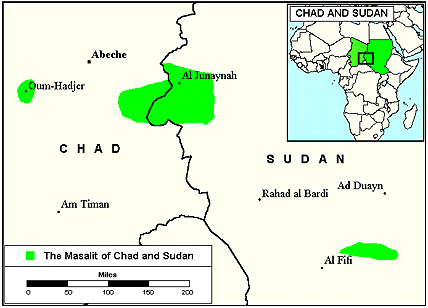

It is unclear whether the word Massalat is an Arabic form of "Masalit," or if the Massalat are actually an offshoot of the Dar Masalit people. It is certain, however, that the two groups are in close contact with each other and share similar customs and traditions. Both the Masalit and the Massalat speak Maba languages from the Nilo-Saharan language family.
In times past, the Masalit were known as fierce warriors who fought hard to protect their independence. Today, they are becoming more settled as a result of outside political, economic and cultural influences. Those who live in Sudan have no choice but to deal with the constant fighting. That might involve moving to safer lands when the situation arises.
The Masalit (and a group of the same people known as the Massalat) are a non-Arab ethnic group. These tribes live in remote areas of western Sudan and Chad. A small number are in Israel.
Masalit marriages generally take place between young couples in their early 20s. Polygamy (the practice of having multiple wives) is permitted and most men have two wives, sometimes more. Unfortunately, divorce is common among the Masalit.
Before a marriage is finalized, a man must pay a bride-price to the woman's family. He is also required to build a house in the bride's mother's compound. The couple will live in that house for at least one year while the new husband works in his mother-in-law's fields. When the couple has their first child, they then decide whether or not to stay in their home or resettle near the husband's family. This decision largely depends on the availability of fields.
The Masalit began converting to Islam during the 1600s; and today they are completely Muslim. They first heard of Islam from Muslim mystics. The Masalit are increasingly becoming more orthodox in their faith. Islamic laws dominate their political and social lives, as well as their values. Most Masalit abstain from alcohol, pray five times a day, and seek religious counsel for important matters. Like most African Muslims, they look to the spirit world for their daily needs. They believe Allah, the god of Islam, is too distant to help them with practical matters.
A majority of the Masalit have not heard a clear presentation of the gospel. This is due in part to their geographical isolation. Who will go to them?
Pray for the Lord to give Masalit elders and family leaders dreams of the righteous and sovereign Lord.
Ask the Lord to send forth laborers to work among the Masalit of Chad and Sudan.
Ask God to use the small number of Masalit believers to share Christ with their own people.
Pray the Masalit people to have the spiritual hunger it takes to seek, find, and embrace the righteous God of Abraham.
Scripture Prayers for the Masalit in Israel.
https://en.wikipedia.org/wiki/Masalit_people
https://www.101lasttribes.com/tribes/masalit.html
| Profile Source: Joshua Project |