


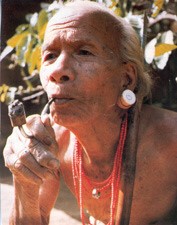

The Maa are one of Vietnam's 54 officially recognized ethnic groups and one of the Central Highlands' most ancient peoples. They concentrate their communities along the upper --ng Nai River in Lâm --ng and --ng Nai provinces, where forests, rivers, and mountains have shaped their culture, language, and spiritual imagination for centuries. Though the modern world presses in from every direction, the Maa carry a distinct identity that their ancestors forged long before Vietnam's current borders existed.
The Maa hold one of the oldest histories in the Central Highlands. Long before French explorers arrived, Maa communities had already developed a stratified society and achieved meaningful political unity, drawing partly on the influence of the ancient Funan empire. Oral traditions speak of a "Ma kingdom," a claim that historians continue to debate but that the Maa themselves regard with quiet pride.
The arrival of French colonialism shattered much of that cohesion. Slave trading, inter-group warfare, and forced displacement tore at the fabric of Maa society throughout the colonial period. Then the Vietnam War descended on the Central Highlands with particular ferocity. Fighting forces moved through Maa territories repeatedly, and the Maa absorbed enormous losses — of people, of villages, of the continuity that sustains a culture. After 1975, the new communist government introduced collectivization schemes and resettlement programs that pushed Maa communities off ancestral lands and into unfamiliar arrangements. State schools began teaching Maa children exclusively in Vietnamese, drawing an entire generation away from their mother tongue. Each of these disruptions left marks that the Maa community continues to process today.
Maa communities organize themselves around the "bon," their word for village. Each bon typically clusters five to ten elongated stilt houses together, with multiple generations of the same family lineage living under one roof. A leader called the "quang bon" — the hamlet chief — guides community decisions, traditionally supported by elders who know Maa customary law deeply and apply it with a reputation for fairness and honesty. The Maa historically built their bons near water streams, in valleys, or on hillsides, and for many generations they moved their villages every decade or two as the soil required.
Farming has always defined the rhythm of Maa life. Traditionally, Maa farmers practiced swidden agriculture. Today, Maa farmers have largely left that nomadic pattern behind and now raise fish, cattle, and poultry for local markets. They apply new agricultural techniques and plant improved varieties, adapting their ancient relationship with the land to the demands of a market economy.
Maa women distinguish themselves through their mastery of textile weaving. They work sophisticated designs of flowers, leaves, birds, and animals into their cloth, producing garments whose colors and patterns identify clan and occasion. The Maa also sustain a rich oral tradition — myths, legends, and ancient tales that elders pass on to younger generations.
The Maa understand the world as alive with spirit. Rivers, mountains, rice fields, forests, and animals all carry spiritual essences that demand acknowledgment, respect, and ritual attention. This animistic worldview does not sit alongside daily life — it organizes it. A farmer consults the spiritual dimensions of planting and harvest. A family building a new home attends carefully to the spirits connected to that land. A wedding and a funeral both require proper ceremonies to navigate the spirit world safely. Even the animals that the Maa raise serve less as commercial livestock and more as offerings prepared for religious rites.
Ancestor veneration deepens this spiritual framework. The Maa believe that deceased family members remain present and influential, capable of blessing or troubling the living depending on whether the living honor them properly. This creates a web of obligation between the generations — one that the gospel must address directly and compassionately to gain a genuine hearing.
A meaningful minority of Maa people have come to faith in Christ, and missiological organizations no longer classify the Maa as "unreached." Yet most of the community still practices traditional animism, and the Christian community — though real and growing — remains young, scattered, and under sustained pressure.
The Maa face layered challenges that touch every dimension of their community life. Economically, many Maa families still struggle to build stable livelihoods in a rapidly changing agricultural economy. The transition from subsistence farming to market participation requires skills, capital, and connections that many Maa households simply do not yet have access to.
Education gaps compound this challenge. Many Maa young people leave school early, leaving them unable to read and limiting their ability to pursue economic opportunities. No complete Bible translation exists in the Maa language, which means that Maa believers must access Scripture in a second language. The Maa language itself faces pressure from Vietnamese — the language of schools, government, and commerce — creating a slow erosion of the linguistic heritage that defines Maa identity.
Pray that God raises up skilled linguists and devoted translators who commit their lives to placing the full Bible in the Maa language, so that every believer can hear God speak directly into their heart tongue.
Pray that the Holy Spirit strengthens Maa believers to stand firm when family members, neighbors, and officials pressure them to abandon their faith and return to animism.
Pray for the Lord to show himself more powerful than the spirit world in such a way they will know they can always depend on him.
Pray that the Holy Spirit sparks a movement to Christ that travels from family to family and from bon to bon until every Maa village shelters a community of believers proclaiming that Jesus Christ is Lord.
Scripture Prayers for the Maa in Vietnam.
PeopleGroups.org
Vietnam Museum of Ethnology / Vietnamese Government Ethnic Minority Portal — cema.gov.vn
Vietnam National Museum of Ethnology — vme.org.vn
Minority Rights Group International — minorityrights.org
| Profile Source: Joshua Project |



