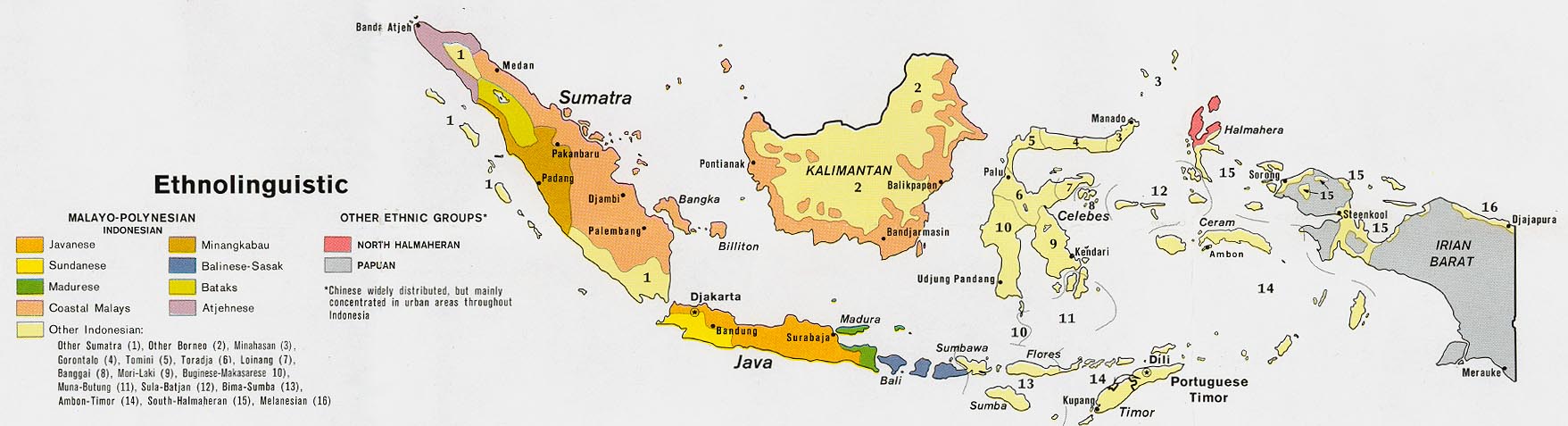
The Kedang (Édang) are an indigenous ethnic group living in the eastern part of Lembata Island in the Eastern Nusa Tenggara Province of Indonesia. Little is known of their history before the late nineteenth century. In the 1870's, the Dutch military helped the leader of the neighboring island of Adonara to gain political control over them. In 1910, the Dutch disarmed and registered the population of the entire island, and from that time on Kedang history became submerged in that of the Dutch East Indies and later, the Republic of Indonesia. Roman Catholic missionaries began working in their midst in the 1920's, but Islam enlisted as many converts as the Catholics. Culturally, linguistically, and spiritually, the Kedang are closely allied with their western neighbors, the Lamaholot, but not to the larger populations of Alor and Pantar. Originally, they lived in villages of a few hundred people composed of named hamlets. These were later reorganized and consolidated by the Indonesian government into administrative villages of 1,000 to 2,000 inhabitants.
In older times, there was no marriage ceremony, but a complicated series of exchanges between families was involved, sometimes even exceeding the lifetimes of the husband and wife.
They speak Kedang, a language of the Austronesian family (sub-family Malayo-Polynesian). The Kedang have a rich oral tradition of storytelling and songs related to the highland environment of their homes. These stories and songs reinforce their social structure and cultural identity and memory.
Their lives are based on subsistence farming, fishing, and weaving. Their weaving is done by males only and utilizes intricate patterns often associated with ancestral customs and rituals reflecting cosmological beliefs. During the rainy monsoon season, many live for extended periods in field huts several miles away from their villages in order to attend to the continuous work in the fields. Modern villages are governed by an elected head, treasurer, and secretary. Contemporary houses are simple bamboo structures supported on house posts, with thatch roofs. In recent years the government and Catholic missions are also encouraging the construction of brick houses with corrugated metal roofs. Staple foods are maize and rice, tubers, vegetables, and spices. Cotton and palm are also grown for local use. Smaller cash crops include copra, tamarind, and candlenuts. Domesticated pigs, chickens, goats and dogs are kept. Schoolteachers earn wages, and some coastal Kedang are petty traders. Young Kedang men increasingly travel, seeking employment from as far away as Malaysia. Traditional division of labor has men fishing, hunting, weaving, and carrying out the extended negotiations necessary for marriage. Women cook, and both sexes are involved in agriculture.
People often marry their cousins. Non-Catholic men are permitted to have several wives, a practice that is infrequent but regular, as is divorce. Newly married couples live with the wife's parents for a few months to a year before establishing their own household. Inheritance is through the father's line.
Children are seldom physically punished. There are no traditional rites of passage, but in early adulthood, the teeth are sometimes filed and blackened, although this is becoming less frequent.
Age is respected, and the elderly are considered as authorities.
The Kedang value harmony with nature. Most are Roman Catholic or Muslim, with some still clinging to traditional spiritual beliefs. As with other eastern Indonesian peoples, the name for God is made of the names for the sun and moon (UlaLoyo). Most marriages now involve at least one partner who is either Catholic or Muslim, so the marriage ceremonies follow that of those religions. There are wife-giving allies and wife-taking allies, with the former being socially superior. The male relatives of the wife watch over the well-being of the children and are considered as divine. There are also guardian spirits of people, villages, fields, houses, and springs, as well as various kinds of "free" spirits and witches. In traditional religion, there are diviners called 'moan-maran pan-kémir' and healers called 'moan-maran potaq-puiq'. Ritual services are held at birth and death, and some villages have reinstated the old practice of ceremonially purifying the village at the beginning of the rainy season. Some kinship groups also hold dry-season rituals for the harvest. Guardian-spirit ceremonies are held in response to misfortune, as well as very occasionally, as a rain-making ceremony. A form of reincarnation is also a part of their belief, with five levels, terminating with the bodies becoming fish in the sea and the souls returning to God.
Infrastructure amongst the Kedang is not well-developed. Increasing drought and environmental degradation have threatened their ability to sustain themselves through agriculture. Youth often migrate to urban areas. Modern development initiatives designed to help them often overlook indigenous perspectives, leading to further degradation of their culture. They have been negatively impacted by gold and manganese mining in their territory that displaces and undermines the livelihoods of the population and creates serious health concerns.
Pray that Christian leaders may be able to use traditional storytelling and music to teach biblical truth and to build the church.
Pray that biblical Christianity may take root so.
Pray that the Kedang will soon take Christ to others, especially Muslims.
Scripture Prayers for the Kedang in Indonesia.
Bing.com search
https://icmagazine.org/indigenous-peoples/kedang/
Kédang | Encyclopedia.com
| Profile Source: Joshua Project |