


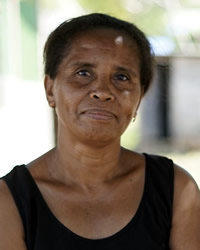

The Kairui-Midik people are a linguistically and culturally distinct ethnic group residing in the rugged, mountainous interior of central Timor-Leste. They primarily inhabit the Manatuto and Viqueque municipalities, with their heartland centered around the administrative posts of Laclo, Laleia, and the high-altitude regions of Ossu. Linguistically, the Kairui and Midiki languages are part of the Kawaimina group—a cluster of languages that also includes Waima'a and Naueti—which are notable for being Austronesian languages with significant Papuan-style grammatical and phonetic influences.
Historically, the Kairui-Midik were isolated by the formidable topography of the Timorese highlands, which served both as a barrier and a refuge. During the Portuguese colonial period and the subsequent Indonesian occupation, these mountain fastnesses were critical sites of resistance and hiding for those fleeing conflict in the coastal lowlands. This history of isolation and resilience has forged a communal identity that is deeply tied to the specific peaks and valleys of their ancestral domain, maintaining a social structure that remained largely autonomous from outside influence for centuries.
The Kairui-Midik are typically multilingual; while they speak their native dialects within their villages, they are proficient in Tetum for trade and interactions with the government.
Life for the Kairui-Midik people is defined by the challenges and rewards of highland subsistence agriculture. Because they live in a region characterized by steep slopes and variable rainfall, families must be exceptionally skilled in managing different microclimates, cultivating maize, sweet potatoes, and various legumes as their primary food sources. In the higher elevations, particularly around Ossu, coffee production serves as the most important cash crop, providing a modest income that allows families to purchase goods they cannot produce themselves. Cattle and water buffalo are of immense cultural and economic value, often used as a form of "living bank" and playing a central role in traditional exchange systems. Their daily existence is marked by a strong sense of communal labor, known as Amo, where neighbors work together to clear land or build houses, ensuring that even the most remote households are supported by the collective strength of the village.
The spiritual life of the Kairui-Midik is a sophisticated synthesis of Roman Catholicism and the ancient indigenous belief system centered on Lulik. While they are devout participants in Catholic rituals and hold the local priesthood in high regard, their worldview is fundamentally shaped by the belief that the landscape is alive with ancestral spirits and supernatural forces. These beliefs are anchored in the Uma Lulik, or sacred ancestral houses, which are presided over by elders who serve as the guardians of oral history and ritual protocol. The Kairui-Midik believe that the health of the community and the success of the harvest depend on maintaining a proper relationship with the ancestors, which requires regular offerings and the strict observance of traditional taboos. Major life events, such as weddings and funerals, are complex affairs that involve both a Catholic mass and traditional ceremonies designed to ensure the spirits of the deceased are properly honored and integrated into the ancestral realm.
The primary needs of the Kairui-Midik people stem from their geographic isolation and the resulting lack of basic infrastructure. The mountain roads connecting their villages to the larger towns of Manatuto and Viqueque are often little more than dirt tracks that become impassable during the rainy season, cutting off access to markets and life-saving medical care. There is a critical need for sustainable, all-weather road development and the construction of bridges over seasonal rivers that frequently isolate entire sub-districts. Healthcare access is a significant struggle, with many rural residents forced to carry the sick on makeshift stretchers over mountainous terrain to reach the nearest clinic. Education is another area of concern; while primary schools are more common, secondary education often requires students to travel far from home, leading to high dropout rates. Additionally, the region faces seasonal water scarcity, particularly during the long dry season, necessitating improved water catchment and irrigation systems to ensure that both livestock and agricultural plots have a reliable supply of water throughout the year.
Pray for the Kairui-Midik people to experience the fullness of the gospel, finding freedom from the fear of ancestral spirits through a deep relationship with Jesus Christ.
Pray for the physical health of those living in remote mountain areas, specifically that they would have better access to healthcare and clean water.
Pray for the youth, that they would be able to pursue their education and find meaningful employment without being forced to leave their families and culture behind.
Pray for their churches to have a powerful visit from the Holy Spirit, drawing hundreds to the true gospel.
Pray that soon Kairui-Midik Christians will become part of God's team, taking Christ to the nations.
Scripture Prayers for the Kairui-Midik in Timor-Leste.
Linguistics: Eberhard, David M., Gary F. Simons, and Charles D. Fennig (eds.). (2024). Ethnologue: Languages of the World. [Kairui-Midiki Language].
Linguistic History: Schapper, Antoinette. (2014). The Papuan Languages of Timor, Alor, and Pantar. De
| Profile Source: Joshua Project |


