


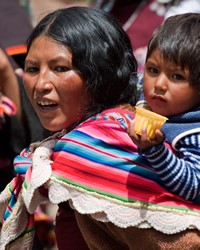

The western Guarani of Bolivia are part of the larger Tupi-Guarani of Brazil and Paraguay. In Bolivia, they are called Chiguano-Chane. (accent on e) They number some 18,000. After Quechua and Aymara, theirs is the third-largest indigenous language of Bolivia. They live in the southeast of Bolivia.
Their history shows that Spaniards were not the only conquerors of Bolivian indigenous peoples because they conquered the native Arawaks in the 13th and 14th centuries. Out of that conquest came the present-day Bolivian people known as Guarani. That blend of people may also account for the existence of two Guarani dialects. The Incas never conquered them. In the 1930s, the Chaco War hit them hard, prompting many to flee Bolivia for Argentina and Paraguay.
Western Bolivian Guarani have a blend of traditional and modern lifestyles. Among them live German Mennonites from other Latin American countries. The Guarani want to develop a tourist industry to attract development and money. Both Mennonite and Guarani housing lack electricity and running water, although such does exist in towns. Laborers work on haciendas, in saw mills, sharecropping, and in commercial agriculture. Economically, as a people, they lack self-sufficiency. They organized a cooperative to protect their interests.
The Western Bolivian Guaranis yearn for a paradise without evil. Shamans play a large role in their lives, principally as healers. Their religion is syncretistic folk-Catholicism. Although initially reached by Catholic missioners, Protestants arrived among them in the 19th and 20th centuries, especially Pentecostals. Thanks to missionaries, they have the Bible in both Guarani dialects. It is available in print, audio, digital, and mobile app formats, and on Kindle.
They need land of their own. They need sustainable living, self-sufficiency, jobs, education, clean water, electricity; in a word, Development. They want to be open to the outside world, especially tourism, and that cannot happen without development. Hence, they need advocacy. They also need to preserve their language, and Bible translation helps with that. However, without electrification, only the printed versions are available.
Pray that the Scriptures will produce a genuine devotion to Christ.
Pray that the church will advocate for them and raise up Christian leaders who will advocate for them.
Pray for development, esp. with the help of Bolivian mission agencies.
Pray that soon Western Bolivian Guaranis will be discipling their children in Christ's ways.
Scripture Prayers for the Guarani, Western Bolivian in Bolivia.
Endangered Languages Archive
BoliviaBella re cooperatives
Wikipedia on Ava Guarani
| Profile Source: Joshua Project |


