


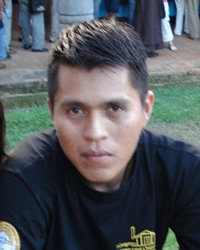

The Chiquitano live in the Gran Chaco of Bolivia, in the Department of Santa Cruz, and in Mato Grasso, Brazil. Few still speak their language. There are five subgroups. Their name refers to the small doors in their houses.
They entered world history with the arrival of the Spaniards in 1542. By 1560, they were conquered, but they fought back.
In 1692, Jesuit missionaries arrived and had little success converting them. They established 10 missions and introduced Spanish culture. By 1767, however, there were some 23,000 converts among a number of groups, the Chiquitano being the largest. Therefore, their language became used, and the Jesuits translated religious material into that language. The Jesuits also protected them from Brazilian slavers. But in 1767, the Jesuits were expelled from the Americas, after which mestizos (mixed-race people) arrived to dominate the area, and debt peonage set in.
Most are still in Bolivia, but there is a small community in Brazil.
From 1945 to 1955, many worked on railroad construction, and many still work on the Santa Cruz to Brazil railroad. Such work has led to assimilation. Until the 1980s, they were serfs. Today, the Jesuit reductions have become thriving self-governing towns with a community labor exchange. Still, they do swidden horticulture, engage in wage labor, work as domestics, or raise chickens and pigs, whose eggs and meat are sold. They also earn a living tapping rubber, making hammocks, and by wage labor. Agriculture consists of growing maize, manioc, peanuts, gourds, pumpkins, pineapples, tobacco, rice, and cacao. Frequent wildfires threaten this livelihood.
Their faith is a mixture of Jesuit Catholicism and indigenous beliefs, in which Jesus has been integrated into their myths as the one who first introduced maize to them. Shamans still cure by sucking out foreign objects and using herbs. (Both sexes may be shamans.) Each natural element is controlled by a "master" being. Liberation theology has also informed their Catholicism and has led them to incorporate as a legal indigenous entity for advocacy.
They need land rights, to escape marginalization and poverty. They need health care and literacy. They also need environmental protection and conservation.
Pray for a genuine Holy Spirit revival that gives them pure devotion to Christ.
Pray for shamans to find their way to the cross and the empty grave.
Pray that they see who Jesus really is and follow him, and only him.
Pray for development so that marginalization will end.
Pray for environmental protection and conservation.
Pray that the church will lead in the quest for land rights for the Chiquitanos.
Scripture Prayers for the Chiquitano in Brazil.
Book: Jurgen Riester, Indians of Eastern Bolivia (1972); and "Chiquitano," Encyclopedia.com.
| Profile Source: Joshua Project |


