


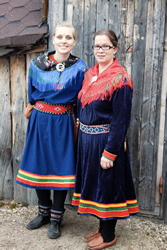

Tucked within the vast subarctic wilderness of Finnish Lapland, the Inari Saami — known in their own tongue as anarâšah — are an indigenous people whose roots reach deep into the forested shores of Lake Inari. Their traditional homeland encompasses the lake's shoreline and surrounding areas, and they hold the distinction of being the only Saami group who live entirely within the borders of a single state and a single municipality. Archaeological evidence places human habitation in the Inari region as far back as eight to ten thousand years, with the earliest peoples sustaining themselves through hunting and fishing in the same boreal landscape that still defines the region today.
Unlike most other Saami groups, the Inari Saami did not historically practice large-scale reindeer husbandry. Fishing and hunting were the more defining features of their culture. Fishing declined in importance as Lake Inari was overfished during the twentieth century, and the main hunting prey — the Finnish forest reindeer — collapsed dramatically in numbers during the eighteenth century.
Christianity arrived in the region during the seventeenth century. The first church was built in the Inari area in 1642, and in the course of the Christian mission, many old traditions disappeared. Finnish migration northward, the disruptions of the Second World War, and decades of assimilation-oriented education policies compounded the pressures on Inari Saami communities. During the Lapland War of 1944, Nazi forces retreating from Finland razed nearly every building in the region, forcing most of Lapland's civilian population — including the Saami — to be evacuated to central Finland or Sweden. Boarding school policies that punished children for speaking their language added further devastation.
The Inari Saami live almost exclusively in the municipality of Inari in Finland's northernmost Lapland — a region of birch forests, frozen lakes, and long arctic winters softened by brief, luminous summers. Although traditional structures such as lean-tos and kotas remain part of the cultural landscape, people today live in modern houses, dress in modern clothes, and do not differ outwardly from other Finns. Nearly all Saami, however, own a traditional dress that is worn on important and ceremonial occasions.
Traditional livelihoods — reindeer husbandry, fishing, hunting, gathering of natural products, and handicrafts — form the foundation of cultural life and maintain a vital link between the people and their land. Food draws heavily from the surrounding environment: reindeer, fish, berries, game, and wild birds are widely used, and gathering and berry picking remain a meaningful part of everyday life.
The vocabulary of the Inari Saami language reflects this way of life — concepts revolving around reindeer herding, small-scale agriculture, hunting, and gathering are woven into the language itself, making direct translation into Finnish extremely difficult. Language revitalization has become one of the defining community efforts of recent decades. The Inari Saami Language Association, founded in 1986, publishes books and magazines and runs language nest immersion programs for young children in Inari and Ivalo. Innovative adult education programs have brought a new generation of speakers into the language, and speaker numbers have grown steadily as a result.
Cultural life is celebrated through festivals, crafts, and music. The town of Inari hosts an annual Indigenous film festival called Skábmagovat — meaning "reflections of endless night" — and a yearly Indigenous music festival called Ijahis Idja, meaning "nightless night." Inari is also home to Sajos, the Saami cultural center and seat of the Saami Parliament, as well as the Siida museum, dedicated to Saami heritage and the natural environment of the region.
The Inari Saami are nominally Christian, affiliated primarily with the Evangelical Lutheran Church of Finland. A Lutheran Saami church stands in the village of Inari — the only Saami church in Finland, in continuous use since 1952, built to replace an earlier church destroyed during World War II. The Laestadian revival movement, which spread through Saami communities across Lapland in the nineteenth century, has also shaped the region's religious character, emphasizing repentance, the forgiveness of sins, and personal faith grounded in Scripture. Yet nominal church membership does not reflect deep or living faith for many, and the proportion of genuine evangelical believers among the Inari Saami remains very small.
Beneath the surface of Lutheran identity, older spiritual currents persist. Inari Saami mythology featured its own distinct gods. The most important was Äijih, who held characteristics similar to the Finnish thunder deity Ukko, while other figures included Piäiváž and ?äcialmai. Sacred sites known as sieidi — often located on the islands of Lake Inari — served as places of offering and veneration. More broadly, traditional Saami spiritual belief is rooted in animism, the conviction that all significant natural objects — animals, plants, rocks — possess a soul, alongside a framework that includes a multitude of spirits. The shaman, known as a noaidi, historically acted as a mediator between the human and spirit worlds, using a drum and chanting to seek guidance or healing from the spirit realm. Shamanism continues to be practiced in some parts of Sápmi, primarily through spiritual healing traditions.
For many Inari Saami, the spiritual world remains present in the lake, the forests, and the turning of the seasons — whether expressed through formal Lutheran practice, older animistic sensibilities, or a blend of both. The Inari Saami language currently has no confirmed Scripture translation, which means the gospel has yet to reach this people in the language of their own hearts.
Many of their challenges they face flow directly from their small population. Language loss, though slowing, continues to threaten the transmission of identity and memory across generations. Economic opportunities have drawn Saami away from their villages to Finnish cities, where linguistic and cultural ties are easily broken.
The absence of Scripture in the Inari Saami language is among the most pressing spiritual needs. Without the Word of God in the language of the heart, lasting transformation and authentic discipleship are difficult to sustain. There are no known evangelical congregations among the Inari Saami, and Christian workers with both cultural sensitivity and linguistic commitment are greatly needed. The Laestadian and Lutheran traditions present in the region have shaped the community's religious vocabulary, but a clear, personal understanding of the gospel — one that produces disciples who make disciples — has yet to take hold among this people.
Pray that God would call and equip workers willing to learn the Inari Saami language and earn the trust of this small, close-knit community.
Ask the Lord to move Bible translation efforts forward so that the Inari Saami would have access to Scripture in their own language.
Pray for Inari Saami men and women within Lutheran and Laestadian circles who may have heard the gospel — that the Spirit would bring them to genuine saving faith and a desire to share it with their own people.
Intercede for Inari Saami families, especially young people navigating life between their indigenous roots and the pressures of broader Finnish society, that they would find their truest identity and deepest belonging in Jesus Christ.
Pray against the spiritual strongholds of animism and veneration of the natural world, and that the truth of Christ as the only mediator between God and humanity would be clearly proclaimed and received.
Ask the Lord to plant a community of disciples among the Inari Saami — however small at first — who know the Scriptures, walk in the Spirit, and carry the light of the gospel into their own language and culture.
Scripture Prayers for the Saami, Inari in Finland.
| Profile Source: Joshua Project |


