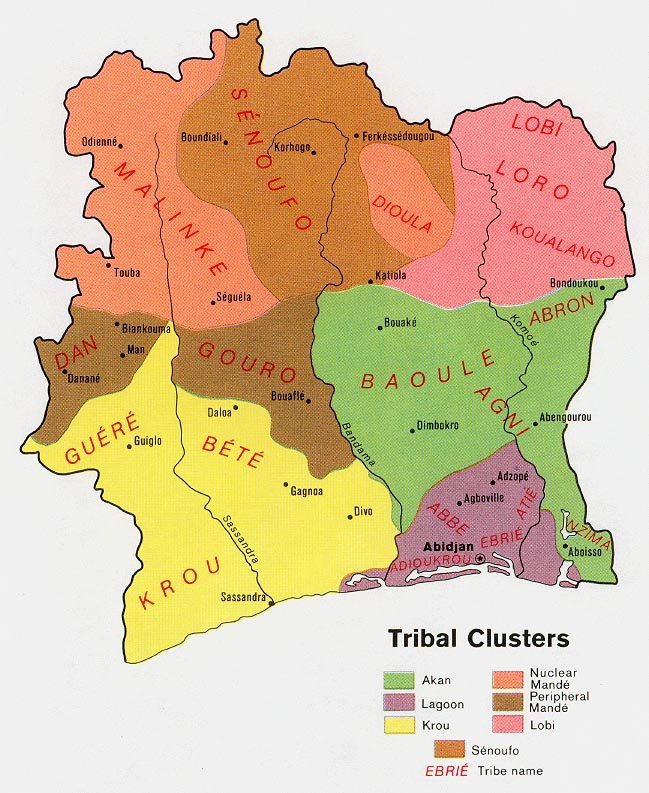
The Goo people live in the Montagnes district of western Côte d'Ivoire, especially in the Biankouma and Man areas, in villages such as Deiné, Déoulé, Glagwin, Gouanlé, Mengouen, Mampleu, Sangoué, Zagoué, and Zeikpopleu.
They speak the Goo language a South Mande language closely related to Tura and Dan but not mutually intelligible with either. Their villages lie between Dan- and Tura-speaking areas, and the Goo people maintain a distinct ethnic identity shaped by their linguistic uniqueness and long-standing presence in the forested highlands.
Goo communities are rural and agricultural. Their region is known for fertile soil, forested hills, and a climate favorable to staple crops. Families engage in farming for daily sustenance, cultivating crops typical to the area such as cassava and other forest-zone staples. The land also allows for small-scale cash crops, and residents may take part in regional trade through nearby towns in the Montagnes region.
Food usually reflects what is grown locally, including cassava-based meals and produce from their fields. Households often include extended relatives, with family cooperation forming the center of daily life.
Celebrations in nearby western Ivorian communities frequently feature masks, dance events, and gatherings that mark agricultural cycles and community identity. Western Côte d'Ivoire is recognized for ceremonies involving masked dancers and communal events associated with local ethnic groups. Given their cultural proximity to Dan and Tura peoples, the Goo likely share similar community-oriented festivities, emphasizing unity and heritage.
Ethnic religious practices remain the primary spiritual framework for most Goo. These beliefs generally involve honoring the spiritual world and maintaining harmony with ancestors and the natural environment. Christianity is present among them, though not dominant. Followers of Jesus affirm that he alone offers hope, peace, and transformation, and Christian families desire to see blessing and spiritual renewal spread throughout their communities.
Villages in the Montagnes district face challenges related to rural isolation, limited infrastructure, and the need for consistent access to healthcare, safe water, and educational opportunities. Some Goo children do not receive schooling in their mother tongue, which affects the transmission of the Goo language and makes learning more difficult. The Goo language is spoken across the community but is not taught in schools.
Spiritual resources are limited. Scripture translation has begun, but broader access to discipleship and biblical teaching is needed to support spiritual growth. Traditional beliefs remain strong, and many have not yet encountered clear teaching about the hope found in Christ.
Pray for improved access to clean water, healthcare, and stable livelihoods for families in Goo villages.
Pray for the preservation of the Goo language and for educational opportunities that strengthen both learning and cultural identity.
Pray that those following Jesus will grow deeply in faith and extend Christ's compassion throughout their communities.
Pray that Goo believers will send workers to peoples around them who still have little or no access to the gospel.
Scripture Prayers for the Goo in Côte d'Ivoire.
https://en.wikipedia.org/wiki/Goo_language
https://llacan.cnrs.fr/fichiers/mandenkan-50/resumes/vydrin.pdf
https://ecotourisme-tai.com/en/exceptional-surroundings/culture-locale/
| Profile Source: Joshua Project |