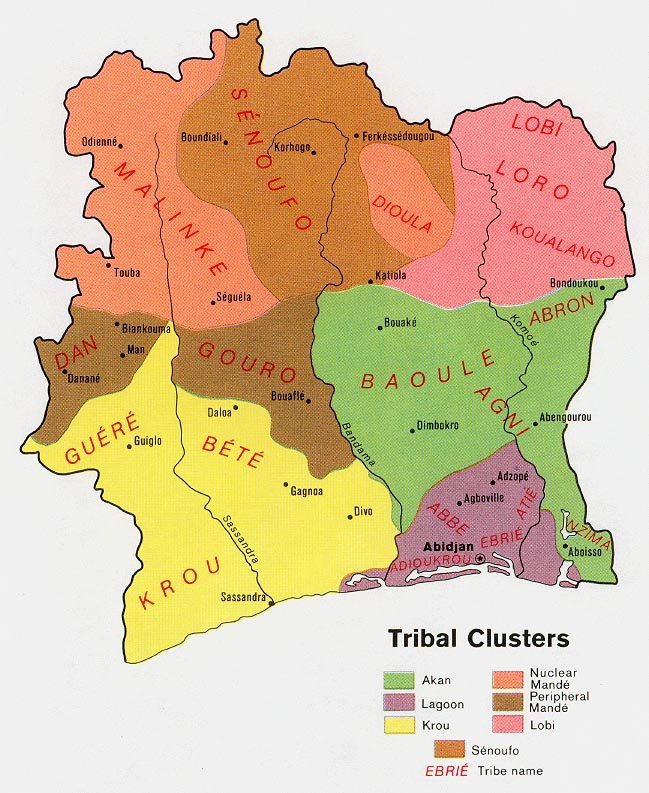
The Wane, also known as Hwané or Ngwané, are an Indigenous Kru-speaking people located along the southwestern coast of Côte d'Ivoire in the Bas-Sassandra District, particularly in the Kounoukou area. Their language, Wané, is part of the Kru branch within the Niger–Congo linguistic family, though it is distinct from the closely related Bakwé and not readily intelligible with it. The Wane also live near neighboring Kru communities such as the Kroumen, Bakwé, and Néyo, forming a cultural landscape shaped by longstanding regional interaction.
Many Wane communities occupy coastal villages such as Monogaga, Kounoukou, Madieko, Popoko, and San Pedro, which is regarded as their central town. Historically, their location along the coast contributed to their multilingual capacity, and they are known for fluency in several regional languages, including Kroumen/Grebo, Bakwé, Bhété, Neyo, Dida, and Wê.
Today the Wane live in coastal settlements that benefit from access to fishing grounds, fertile soil, and trade links with inland areas. Their villages are known for scenic beaches and a relaxed coastal environment that supports both fishing and small-scale agriculture. Many households cultivate local crops, gather forest products, or engage in artisanal work, while others participate in the broader regional economy centered around the port city of San Pedro. Family life often revolves around kinship networks, shared labor, and community decision-making rooted in ancestral traditions.
Their diet includes fish from coastal waters, cassava, plantains, palm products, and other locally grown foods typical of southwestern Côte d'Ivoire. Social gatherings often feature music, storytelling, and communal meals, with festivals tied to agricultural cycles, coastal activities, or local traditions celebrated across Kru communities. Access to modern institutions varies by village, but regional centers such as San Pedro offer expanded opportunities for schooling and commerce.
The Wane traditionally adhere to ethnoreligious beliefs characteristic of many Kru peoples, involving ancestral reverence, nature-associated spiritual practices, and community rituals that mark important events. Some also engage with forms of Christianity, which have taken root in varying degrees through mission influence and regional church networks. Their spiritual worldview often blends longstanding cultural practices with newer expressions of Christian faith.
Economic development and sustainable livelihoods remain a concern as coastal communities face pressures related to changing markets, limited infrastructure, and environmental challenges. Educational opportunities, particularly in more remote villages, would strengthen long-term stability and help younger generations navigate economic change. Spiritually, many Wane would benefit from consistent access to Scripture and biblically grounded teaching, especially since their language has no reported Bible translation or Christian media resources. Where Christian communities are present, believers have the potential to grow in discipleship and serve as an active gospel force among neighboring ethnic groups that have even fewer encounters with the message of Jesus Christ.
Pray for improved access to education, health services, and sustainable economic opportunities among Wane families.
Ask the Lord to open hearts to the mercy and salvation offered through Jesus Christ and to strengthen existing churches among them.
Pray for progress in language development and future Bible translation efforts so that the Wane may engage Scripture in their own tongue.
Pray that Wane believers will grow in maturity and become part of the broader missionary movement reaching less-reached peoples in West Africa.
Scripture Prayers for the Wane in Côte d'Ivoire.
https://upg.io/languages/hwa
https://en.wikipedia.org/wiki/Wan%C3%A9_language
https://www.rezoivoire.net/ivoire/patrimoine/4316/a-la-decouverte-du-peuple-wane.html
https://lingweb.eva.mpg.de/channumerals/Wane.htm
| Profile Source: Joshua Project |