
The self-name of this tribe is Nyahkur, which means "people of the forest." The Thais call them Chaobon, meaning "people of the hills." The Nyahkur consider this latter term derogatory.
Despite their small numbers, the Nyahkur are considered a historically important group. Many linguists believe that their language is a link between Mon and Khmer. One scholar says, "Their language contains so many Khmer and Mon words that some linguists consider the language as a bridge—even more closely related to ancient Mon than to the modern Mon dialect." Today, most Nyahkur children and youth primarily speak Thai and the Isan Thai dialect.
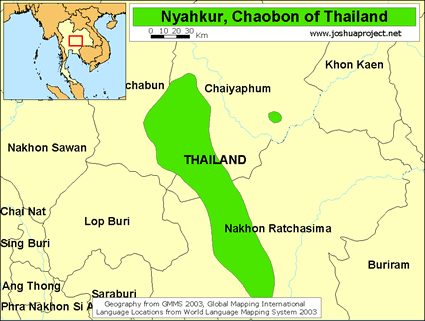
The Nyahkur people comprise one of Thailand's least known tribes. They inhabit valleys surrounded by lush hills in the three central Thailand provinces of Chaiyaphum, Nakhon Ratchasima and Phetchabun.
Nyahkur life is simple and unadorned. When they are joyful, they sing and dance. Pa-Re-Re folk songs are accompanied by the Taphon, which is a large, barrel-shaped Mon drum. The music is gentle yet rhythmic, with lyrics that speak of greetings, daily life, teaching, praise, courtship, and storytelling. Singers are divided into male and female groups who respond to each other in quick exchange, with no limit to group size. They form a circle on the floor, with a music teacher or elder seated in the center. Someone recites lyrics for both sides, while women take responsibility for drumming. Pa-Re-Re songs are usually performed at night and sometimes continue until dawn. Their music carries simple melodies deeply connected to the forest, often imitating the percussive tones and rhythms of nature. These traditional Pa-Re-Re folk songs are sometimes used as a way for young men and women to express affection for one another. There is a bride price for Nyahkur weddings based on the woman's beauty, her abilities as a worker and the wealth of her parents.
In the past the Nyahkur were animists enslaved to powerful demons. In recent decades, due to the influence of their Thai and Isan neighbors, they have embraced Buddhism. Practically all Nyahkur now claim to be Buddhists. However, they have retained most of their former animistic practices and placed a veneer of Buddhism over them. The Nyahkur believe in various spirits: village guardian spirits, mountain spirits and soil spirits. They call these spirits nthock. They blame evil spirits for almost everything that goes wrong. They believe that if they wear a necklace made of flat pieces of copper to protect them against nthock lakthep, the most powerful evil spirit. The Nyahkur wear charms and amulets, such as Buddhist images, necklaces of beads and old silver coins.
Despite more than 40 years of missionary effort, there has not been a spiritual breakthrough. A team of missionaries first moved into the village of Ban Wang Ai Pho in 1982, and they have worked there since. One source says, "They were not successful in baptizing the Chaobon [Nyahkur] people, because of the superstitious and animistic nature of their beliefs. But they were very successful in studying and preserving Chaobon culture and they gave a helping hand in social, health, administrative, and human matters."
Pray for them to put all their trust in Jesus Christ rather than walking in fear to the spirit world.
Pray God will have mercy on the Nyahkur, doing whatever it takes to place them in a position to receive his eternal blessings.
Ask God to open the hearts of the Nyahkur to the gospel.
Pray for an unstoppable movement to Christ among them.
Scripture Prayers for the Nyahkur in Thailand.
Peoples of the Buddhist World, Asia Harvest, Copyrighted © Used with permission.
Mission Pathway newsletter, March 2026.
| Profile Source: Joshua Project |