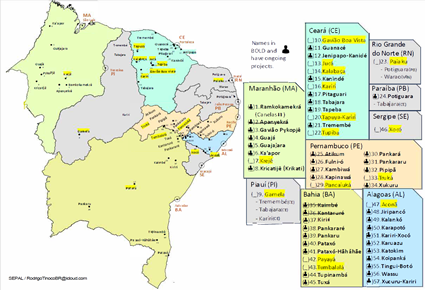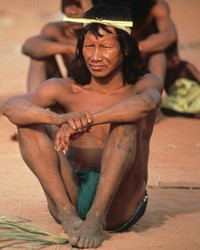

The Canela are an indigenous people of northeastern Brazil who belong to the wider Timbira cultural group of the Jê-speaking peoples. The name "Canela" has been used to describe closely related communities, especially the Ramkokamekrá and the Apanyekrá, who share similar language and cultural traditions. Their own names for themselves often differ from the Portuguese label commonly used by outsiders.
Historically, the Canela lived across areas of savanna and woodland in what is now the Brazilian state of Maranhão. Early accounts describe them as living in large, well-organized villages and maintaining strong social and ceremonial traditions. Over time, contact with settlers, disease, and outside pressures significantly disrupted their communities. Despite these challenges, the Canela have worked to maintain their cultural identity and traditional ways of life. Today they remain recognized as an indigenous people of Brazil and continue to preserve many elements of their language, customs, and social structures.
The Canela traditionally live in villages arranged in a circular pattern, with homes placed around an open central area used for meetings, ceremonies, and community activities. This layout reflects their social organization and the importance of shared life within the community.
Their society has long included structured age groups and ceremonial associations that help guide community responsibilities and celebrations. These systems help maintain social unity and reinforce the values of cooperation, respect for elders, and communal identity.
The Canela language belongs to the Northern Jê branch of the Macro-Jê language family and is closely related to other Timbira languages spoken by neighboring indigenous groups. Many Canela people also speak Portuguese when interacting with the broader society of Brazil, but their native language remains an important marker of identity.
Traditionally the Canela relied on hunting, fishing, and gathering, along with small gardens where crops were cultivated. Life in the savanna environment of Maranhão required knowledge of seasonal changes, wild plants, and animal behavior. Ceremonies, storytelling, and communal events continue to play an important role in strengthening cultural traditions and passing knowledge to younger generations.
Traditional Canela spirituality has been shaped by indigenous religious practices that focus on the spiritual forces believed to be present in the natural world. Ceremonies, rituals, and traditional leaders play roles in maintaining harmony between people, the community, and the environment.
At the same time, the message of Jesus Christ has reached the Canela through Christian witness. Some individuals and families now identify as Christians, and there are believers among them who desire to follow Christ while living within their cultural context. The New Testament and other Christian resources are available in their language, giving opportunities for people to hear and read the message of the gospel in a form they can understand.
The Canela continue to face the challenge of maintaining their cultural identity while interacting with the wider society around them. As with many indigenous communities, preserving language, traditions, and community life requires ongoing effort.
Spiritually, believers among the Canela benefit from encouragement, discipleship, and opportunities to grow in their understanding of scripture. Access to biblical teaching and culturally appropriate Christian fellowship can help strengthen the faith of those who have come to Christ.
There is also a need for continued translation work, teaching materials, and local leadership development so that the message of the Bible can take deeper root within the community. When the gospel is shared in ways that respect language and culture, it can help nurture a strong and lasting church among the Canela people.
Pray that the Canela people will clearly hear and understand the good news of Jesus Christ in their own language.
Pray for believers among the Canela to grow strong in their faith and to become faithful witnesses to their own communities.
Pray for wise and godly local leaders who can shepherd believers and teach the Scriptures faithfully.
Pray for families and communities to experience hope, peace, and transformation through the power of the gospel.
Pray that the Lord will raise up workers who will serve alongside the Canela with humility, love, and respect for their culture.
Scripture Prayers for the Canela in Brazil.
https://en.wikipedia.org/wiki/Canela_people
https://www.everyculture.com/South-America/Canela-Orientation.html
https://en.wikipedia.org/wiki/Canela_dialect
https://pt.wikipedia.org/wiki/L%C3%ADngua_canela
https://peoplegroups.org/people_groups/pg016797/
| Profile Source: Joshua Project |