Durava in Sri Lanka

Send Joshua Project a photo
of this people group. |
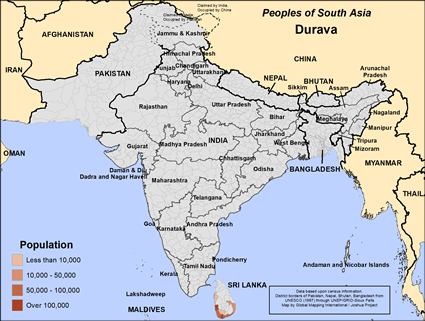
Map Source:
People Group data: Omid. Map geography: UNESCO / GMI. Map Design: Joshua Project
|
| People Name: | Durava |
| Country: | Sri Lanka |
| 10/40 Window: | Yes |
| Population: | 784,000 |
| World Population: | 784,000 |
| Primary Language: | Sinhala |
| Primary Religion: | Buddhism |
| Christian Adherents: | 8.12 % |
| Evangelicals: | 0.00 % |
| Scripture: | Complete Bible |
| Ministry Resources: | Yes |
| Jesus Film: | Yes |
| Audio Recordings: | Yes |
| People Cluster: | South Asia Buddhist |
| Affinity Bloc: | South Asian Peoples |
| Progress Level: |

|
Introduction / History
The Durava people are a Sinhalese coastal caste primarily concentrated in the southern and western regions of Sri Lanka. They speak Sinhala, the national language of Sri Lanka. Historically, the Durava trace their origins to South India, migrating between the 13th and 18th centuries. Many claim descent from ancient Naga tribes and aristocratic families, and some traditions link them to royal service as soldiers and elephant keepers.
During Portuguese colonial rule in the 16th century, a portion of the Durava converted to Catholicism, though most later embraced Theravada Buddhism. They played a significant role in the Buddhist revival during the British colonial era and have been active in Sri Lankan politics and commerce.
Durava communities are largely urban and semi-urban, with concentrations in Colombo, Galle, and Matara.
What Are Their Lives Like?
Many families own coconut lands, and historically they were involved in toddy tapping, though this association is now minimal and often rejected by the community. Today, Durava people work in diverse fields such as agriculture, trade, government service, and professional sectors. Education is highly valued, and younger generations increasingly pursue higher education and white-collar jobs. Social life is shaped by kinship networks and caste identity, though modern economic mobility has softened traditional boundaries.
What Are Their Beliefs?
The Durava are predominantly Theravada Buddhists, practicing rituals tied to temples and festivals such as Vesak and Kataragama pilgrimages. A minority remains Catholic, reflecting Portuguese influence, and small numbers identify as Protestant Christians. Buddhism is central to their cultural identity, emphasizing merit-making, temple donations, and honoring monks. While Buddhism discourages caste distinctions, social stratification persists informally. Evangelical witness among the Durava is minimal, and biblical understanding is rare.
What Are Their Needs?
Economic modernization has improved living standards, but challenges remain. Many Durava families face underemployment and rising costs in urban areas. Access to quality education and healthcare can be uneven, especially outside major cities.
Spiritually, the Durava lack exposure to the gospel and often view Christianity as culturally foreign. There is a need for culturally sensitive evangelism and discipleship that addresses both spiritual hunger and practical concerns. Communities require hope beyond material success, as traditional beliefs offer little assurance of eternal life.
Prayer Points
Pray for improved educational and economic opportunities for Durava families, especially in rural areas.
Ask God to raise up workers who will lovingly share Christ among the Durava and demonstrate his compassion through practical service.
Intercede for Buddhist and Catholic Durava to encounter Jesus through Scripture, media, and relationships.
Pray that emerging Durava believers will grow in faith and become part of the global discipleship movement.
Seek God's blessing on efforts to overcome social barriers so that the gospel can flow freely within their communities.