Telengit in Russia
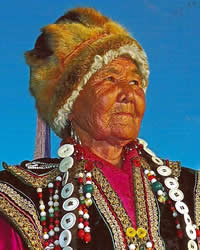
Photo Source:
Z. U. - Flickr
Creative Commons
|
Send Joshua Project a map of this people group.
|
| People Name: | Telengit |
| Country: | Russia |
| 10/40 Window: | No |
| Population: | 3,700 |
| World Population: | 3,700 |
| Primary Language: | Altai, Southern |
| Primary Religion: | Ethnic Religions |
| Christian Adherents: | 8.00 % |
| Evangelicals: | 5.70 % |
| Scripture: | New Testament |
| Ministry Resources: | Yes |
| Jesus Film: | Yes |
| Audio Recordings: | Yes |
| People Cluster: | Ural-Siberian |
| Affinity Bloc: | Turkic Peoples |
| Progress Level: |

|
Introduction / History
The Telengit are a Turkic indigenous people of the Altai Republic, a federal subject of Russia nestled in the heart of the Altai Mountains in southern Siberia, where the borders of Russia, Mongolia, China, and Kazakhstan converge. Their ancestral territory lies primarily along the Chuya and Chulyshman River systems in the Kosh-Agach and Ulagan districts of the republic — a landscape of sweeping highland steppes, glacial valleys, and soaring peaks that the Telengit regard as sacred and inseparable from their identity. They belong to the southern Altai branch of the Turkic peoples and have inhabited this region since ancient times, with early Chinese chronicles possibly referencing their ancestors as far back as the medieval period.
The Telengit speak Telengit, a dialect of Southern Altai within the broader Turkic language family, and it remains one of the more robustly transmitted indigenous languages of the Russian Federation. In the Kosh-Agach District, many community members maintain trilingualism in Telengit, Russian, and Kazakh. This relative linguistic vitality stands in contrast to many of Russia's other small-numbered indigenous peoples, whose languages are critically endangered.
For centuries the Telengit maintained semi-independence, navigating relationships between the Russian Empire and the Dzungar Khanate before being formally incorporated into Russia in 1864 and 1865. The Soviet era brought collectivization, the suppression of traditional religious and cultural practices, and the reclassification of the Telengit as a subgroup of the broader Altai people — a designation that erased their distinct identity for decades. Recognition as a separate indigenous people was restored only in 2000, when the Telengit were formally listed among Russia's small-numbered indigenous peoples of the North, Siberia, and the Far East. The establishment of the Telengit Cultural Center in Kosh-Agach that same year marked a new chapter of cultural revitalization.
What Are Their Lives Like?
Life for the Telengit is shaped by the extreme highland terrain and climate of the southern Altai, where winters are severe and summers are short. Traditional semi-nomadic herding remains an important part of Telengit livelihood, with families raising sheep, cattle, goats, and horses across seasonal pastures. Many Telengit continue to practice subsistence herding and agriculture, supplemented by hunting and gathering of wild plants, though state-era restrictions on livestock numbers in collective farms created lasting economic frustrations that persist in various forms today.
Meat and dairy products form the core of the Telengit diet, including fermented milk beverages and a variety of curds, cheeses, and butter. Barley, millet, and wild edible plants supplement meat-based meals, and the cuisine reflects both the practical realities of high-altitude pastoral life and the deep cultural connection to the animals and land that sustain the community.
Family life is organized around the patrilineal clan system, called the seok — a descent line that historically governed marriage, taxation, and community obligation. Clan identity continues to carry cultural weight even as Russian administrative structures overlay traditional governance. Music, oral tradition, throat singing, and the recitation of heroic epic poems are living arts among the Telengit, and the inter-regional folk festival Al Oiyn and the folklore festival Jaear, held in the Altai Republic, bring communities together in celebration of shared Turkic cultural heritage. The Telengit Cultural Center in Kosh-Agach actively preserves and performs traditional music, clothing, and crafts.
What Are Their Beliefs?
The primary religious identity of the Telengit is rooted in ethnic religion — specifically shamanism and Burkhanism, an indigenist spiritual movement that arose in the Altai region in 1904. Traditional Altai shamanism centers on the belief that the world is animated by spirits residing in the land, rivers, mountains, and sky, and that trained spiritual practitioners serve as intermediaries between the human community and these spiritual forces. For many Telengit, the land itself is sacred — a living spiritual reality rather than merely a physical resource — and religious rituals, traditions, and customs are woven into daily life and the care of the natural environment.
Burkhanism incorporates elements of shamanism, Buddhism, and millenarian hope but remains distinct from Christianity and from Buddhist practice in its specifically Altai expression. Russian Orthodox Christianity was introduced to the Altai region through nineteenth-century missionary activity, and nominal Orthodox identity exists among some Telengit, particularly those with greater exposure to Russian cultural influence. However, evangelical Christian faith has made little documented impact among the Telengit, and they remain an unreached people group with no known sustained gospel witness within their community.
What Are Their Needs?
The Telengit face significant physical challenges rooted in geographic isolation, poverty, and the lingering economic effects of Soviet-era policies. The Kosh-Agach District ranks among the most economically marginal regions of the Altai Republic, with limited access to quality healthcare, advanced education, and stable employment beyond traditional herding and subsistence agriculture. Restrictions on land use and natural resource management continue to constrain traditional livelihoods. The community has also faced pressure from proposed development projects — including an oil pipeline once planned through their sacred highlands — that threatened ancestral lands and spiritual sites.
Spiritually, the Telengit live within a worldview in which the spirit world is real, pervasive, and must be appeased through ritual and ceremony. This awareness of unseen spiritual forces opens a door to the gospel — the good news that Jesus Christ has authority over every spirit and power, and that through his death and resurrection, men and women can be reconciled to the living God. No evangelical mission is known to be actively working among the Telengit, and Scripture resources in the Telengit language are extremely limited. Workers with cross-cultural calling, willingness to learn a Turkic language, and love for remote mountain peoples are urgently needed among this overlooked community.
Prayer Points
Pray that God will call and equip evangelical workers who will commit to living among the Telengit, learning their language, and faithfully proclaiming the gospel of Jesus Christ in the remote valleys of the Altai.
Pray that the Telengit, already deeply aware of the spiritual world, will encounter the risen Christ and find in him the truth, freedom, and peace that shamanism cannot provide.
Pray for the translation of the New Testament and gospel resources into the Telengit language so that the good news can be heard and read in the heart language of the people.
Pray for the physical flourishing of the Telengit — for economic opportunity, healthcare access, the protection of their ancestral lands, and the wellbeing of their families and communities.