Chambri, Tchambuli in Papua New Guinea
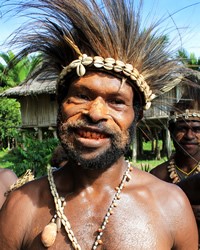
Photo Source:
Anonymous
|
Send Joshua Project a map of this people group.
|
| People Name: | Chambri, Tchambuli |
| Country: | Papua New Guinea |
| 10/40 Window: | No |
| Population: | 4,700 |
| World Population: | 4,700 |
| Primary Language: | Chambri |
| Primary Religion: | Christianity |
| Christian Adherents: | 70.00 % |
| Evangelicals: | 14.00 % |
| Scripture: | Translation Started |
| Ministry Resources: | No |
| Jesus Film: | No |
| Audio Recordings: | Yes |
| People Cluster: | New Guinea |
| Affinity Bloc: | Pacific Islanders |
| Progress Level: |

|
Introduction / History
The Tchambuli Chambri are a Papuan people living in the Chambri Lakes region of East Sepik Province in Papua New Guinea. Their villages of Indingai, Wombun, and Kilimbit are situated along the shores of Chambri Island, a mountainous island rising above the shallow, fish-rich waters of Chambri Lake. The lake itself is formed by the overflow of tributaries of the Sepik River, one of the great waterways of the Pacific world, and the surrounding landscape of wetlands, dense forest, and interconnected waterways has shaped Tchambuli Chambri life and identity across many generations.
The Tchambuli Chambri speak the Chambri language, which belongs to the Ramu-Lower Sepik language family. Their language is geographically distinct, surrounded as it is by Sepik languages, giving the Chambri a linguistic identity that stands apart from neighboring peoples. The Chambri have lived in this lake region for an estimated thousand years, having coalesced from earlier dispersed bands partly in response to pressure from neighboring peoples such as the Iatmul, a larger and more expansive group along the Sepik River. For much of their history, the Tchambuli Chambri maintained an extensive regional trading network, exchanging fish, tools, and other goods with communities in the surrounding Sepik Hills and along the river.
Outside contact came gradually through Australian colonial administration beginning in the early twentieth century. Catholic missionaries also entered the region, and by the mid-twentieth century a substantial church had been established at Indingai village. These encounters brought significant changes to Chambri society, economy, and spiritual life, and their effects continue to shape the community today.
What Are Their Lives Like?
Life among the Tchambuli Chambri is closely bound to the lake and its waters. Fishing has long been the foundation of the community's food supply and its primary medium of trade, and that relationship with Chambri Lake continues to define daily rhythms and social patterns. Surplus fish are taken by women to barter markets in the Sepik Hills, where they are exchanged for sago, the starchy staple derived from palm trees. This fish-for-sago exchange has persisted across generations and remains an important feature of the Tchambuli Chambri economy, though the broader trading networks of the Sepik region have changed considerably with the introduction of cash markets and modern goods.
Within the community, men and women occupy distinct but complementary roles. Women take primary responsibility for fishing, food preparation, and trade, while men have traditionally been more involved in community governance, ritual responsibilities, house and canoe building, and the production of carved artifacts. Today, both men and women participate in producing woodcarvings and woven goods for markets and visitors, reflecting the community's adaptation to changing economic circumstances.
Village life remains organized around extended family and clan networks. Men's houses, which are traditionally impressive two-story structures with elaborately carved interior timbers, continue to serve as centers of male community life, though their role has evolved over time. Tok Pisin is widely spoken alongside Chambri, providing a bridge for communication with other communities, traders, and church workers across the broader region. Younger community members may travel for education or employment, while elders and families remain rooted in the village.
What Are Their Beliefs?
The Tchambuli Chambri have a significant and longstanding Christian presence within their community, the result of missionary work that began in the region during the twentieth century. Catholic missionaries established a church at Indingai village, and the influence of Christianity has remained part of community life since that time. The Chambri are classified as significantly reached, reflecting a meaningful degree of Christian identification and evangelical presence among them.
As in many communities across Papua New Guinea where Christianity has taken root over several generations, the depth and character of Christian commitment can vary from household to household and village to village. Traditional worldviews, practices, and community ceremonies may continue to exist alongside Christian profession in some contexts. Where this is the case, the community needs the continued, patient ministry of the gospel to move from cultural identification with Christianity toward genuine, transforming faith in Jesus Christ as Savior and Lord.
Bible translation work in the Chambri language has been started, which is a meaningful development, though no completed New Testament or full Bible portions have yet been reported as available in the language. Audio gospel recordings exist in Chambri and are accessible through Global Recordings Network. Topical scripture booklets and Bible studies in the language are also available through World Missionary Press, providing additional tools for outreach and discipleship. These resources represent important foundations, yet the need for continued translation work and deeper access to God's Word in the Chambri heart language remains real.
What Are Their Needs?
The community also needs strong, biblically grounded local leadership—pastors and teachers who can shepherd their congregations not merely through cultural tradition and nominal affiliation but through clear, faithful teaching of the gospel of Jesus Christ. Where traditional beliefs and practices continue to coexist with Christian profession, the church needs the courage and equipping to speak the truth of Christ's sufficiency with clarity and love.
Practical challenges are present as well. The Tchambuli Chambri face the pressures of economic change, as traditional trading systems have become less stable with modernization. Younger generations navigating the tension between village life and the wider world need grounding in the truth that only Christ can provide. Families need the stability and hope of the gospel, and the church among the Tchambuli Chambri needs the prayers and partnership of the wider body of Christ.
Prayer Points
Pray for the completion of Bible translation work in the Chambri language, that the full word of God would in time be available to every Tchambuli Chambri speaker in their heart language, and that this Word would take deep root in the community.
Pray for Tchambuli Chambri believers, that their faith would move from nominal Christian identification to a living, personal knowledge of Jesus Christ, and that the Holy Spirit would bring genuine renewal and growth.
Pray for Tchambuli Chambri families, that parents would model living faith to their children and that the next generation would grow up knowing and trusting in Christ rather than drifting toward the pressures and distractions of a changing world.
Pray for those involved in gospel audio recording, topical scripture distribution, and Bible translation among the Tchambuli Chambri, that God would bless these resources and use them to transform hearts and lives.
Pray that the Tchambuli Chambri church would not only deepen in its own faith but would develop a vision to bring the gospel to unreached peoples in Asia.